# AI Adaptive Learning Graph Standard
**URL:** https://connect.oeglobal.org/t/ai-adaptive-learning-graph-standard/9400
**Category:** Sharing Zone
**Created:** [September 17, 2026, 9:42pm UTC](https://connect.oeglobal.org/t/ai-adaptive-learning-graph-standard/9400 "2026-09-17T21:42:09Z")
**Posts on this page:** 5
**Page:** 1
### Author:  [@Mauricio](https://connect.oeglobal.org/u/Mauricio)
#### Post date: [September 17, 2026, 9:42pm UTC](https://connect.oeglobal.org/t/ai-adaptive-learning-graph-standard/9400/1 "2026-09-17T21:42:09Z")
Hello
I have just published one of my most ambitious projects: Edukors Graph, an open standard (and the tools around it) for building learning graphs with nodes (what the student sees) and edges (where they go next).
Edukors Graph makes adaptive, personalized learning accessible to every educator. Using AI, teachers can create learning paths with many branches that adapt to each student’s context, instead of the same linear path for everyone. Teachers with no technical background can build complex courses that deliver personalized learning.
Edukors Graph is not an app. It is a standard, as SCORM and LTI are. It is a set of specifications to be read by computer systems, both to generate adaptive courses and to present them to students.
This project is free, MIT License, open source and community-driven. Contributions of any size are welcome.
> **[GitHub - mgarlabx/edukors\_graph](https://github.com/mgarlabx/edukors_graph)**
>
> Contribua para o desenvolvimento do mgarlabx/edukors\_graph ao criar uma conta no GitHub.
A good starting point is to download the skill and run it on your AI (Claude Code, Codex, etc.). Install it in a folder and ask it to create a course with a specific number of nodes. Start small. Later, you’ll realize that the better you specify the course, the steps, the objectives, etc., the better the delivery will be.
---
### Author:  [@Mauricio](https://connect.oeglobal.org/u/Mauricio)
#### Post date: [September 21, 2026, 5:56pm UTC](https://connect.oeglobal.org/t/ai-adaptive-learning-graph-standard/9400/2 "2026-09-21T17:56:48Z")
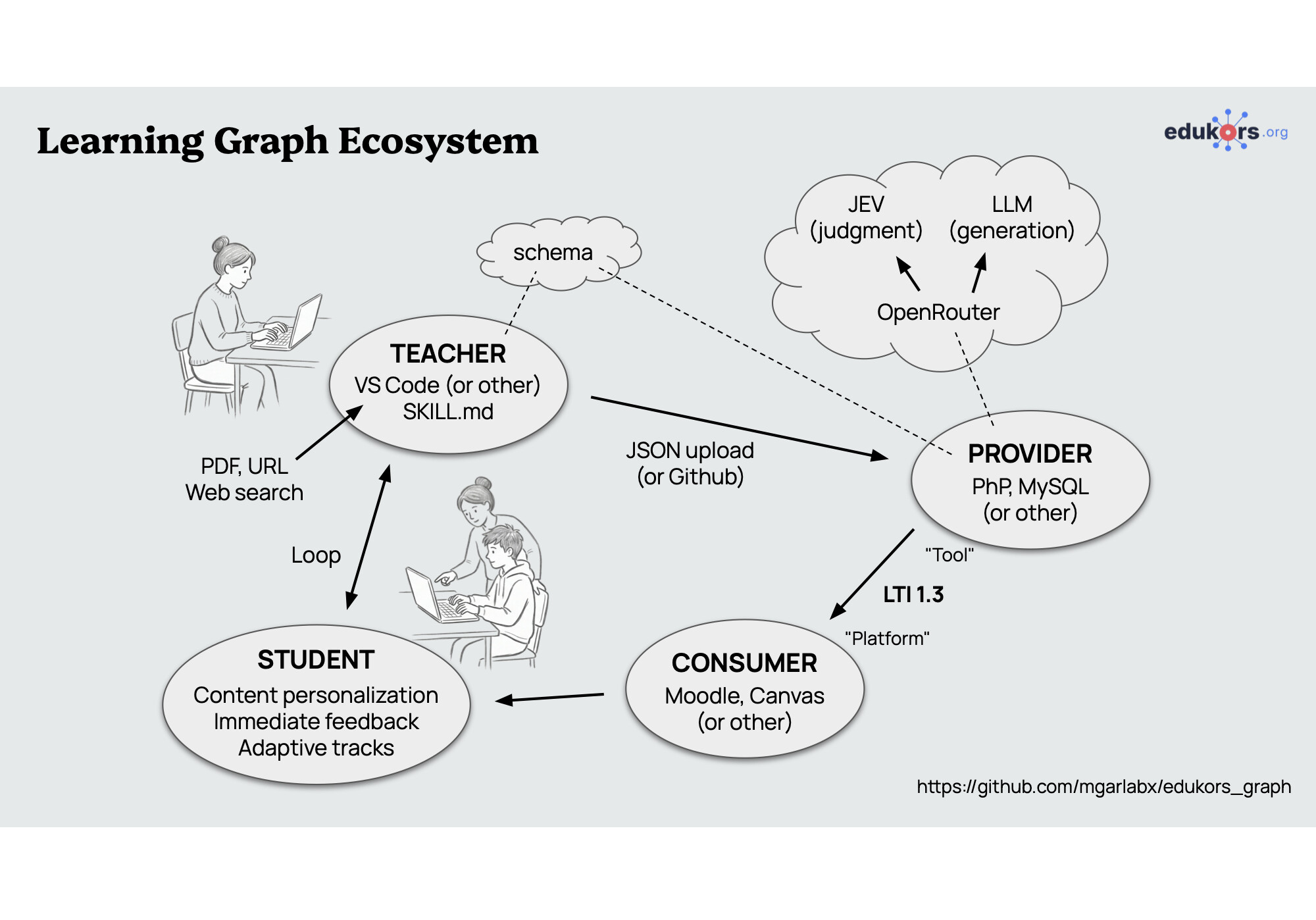
I updated my original proposal to use the new JEV model from Typesafe. It now looks like this:
1. Teacher: creates the content in VS Code (or another tool) with a “skill,” using PDFs, URLs, and web searches.
2. Provider: receives the graph in JSON (upload or GitHub) and uses, via OpenRouter, JEV to direct the learning paths and an LLM to generate personalized content.
3. Consumer: Moodle, Canvas, or another LMS integrates everything via LTI 1.3, without the student needing to leave the platform they already use.
4. Student: receives personalized content, immediate feedback, and adaptive learning paths. What they produce goes back to the teacher, closing the loop.
Each activity is a node in the graph, and the next one can be defined in three ways:
- Direct: no decision, follows the flow.
- Deterministic: the student chooses or the quiz score decides.
- Stochastic: An AI “judge” (JEV) evaluates and decides.
The next node can be static, generated beforehand, or dynamic, generated by LLM in real time.
The teacher remains in control of the pedagogical design, and the AI handles the adaptation. Everything is open and free, a non-profit effort to help educators worldwide work with artificial intelligence.
* * *
# How to get started:
- Download the skill and use it with your AI:
[https://edukors.org/skills/?download=edukors-graph-builder](https://edukors.org/skills/?download=edukors-graph-builder)
For example, ask:
“Develop a course on domestic and wild felines, in ten steps. Start by assessing whether the person knows the difference between domestic and wild. If not, explain. Offer options for further study, at the user’s discretion, including anatomy, feeding, and reproduction.”
# How to delve deeper
Read the README and clone the repository:
> **[GitHub - mgarlabx/edukors\_graph](https://github.com/mgarlabx/edukors_graph)**
>
> Contribua para o desenvolvimento do mgarlabx/edukors\_graph ao criar uma conta no GitHub.
---
### Author:  [@cogdog](https://connect.oeglobal.org/u/cogdog)
#### Post date: [September 21, 2026, 7:20pm UTC](https://connect.oeglobal.org/t/ai-adaptive-learning-graph-standard/9400/3 "2026-09-21T19:20:10Z")
Thanks for sharing your project Mauricio, I’m trying to wrap my brain around it, so your new diagram helps. Is there a place to see an example of these courses in action? I was looking at the samples directory which are all raw HTML.
I also wonder too about any connection in a slightly different project by @yasin.dahi at [GenOER](https://genoer.org/) where he had a system of autunomus educator and designer AI agents working together to creatre interactve activities (if I am remembering correctly) see [https://genoer.org/about](https://genoer.org/about)
---
### Author:  [@Mauricio](https://connect.oeglobal.org/u/Mauricio)
#### Post date: [September 21, 2026, 8:45pm UTC](https://connect.oeglobal.org/t/ai-adaptive-learning-graph-standard/9400/4 "2026-09-21T20:45:01Z")
Hi, Alan. Thanks for the feedback.
1. Catalog access
I’m still working on a public course catalog, and you can preview it at [Courses — Edukors](https://edukors.org/graphs/catalog/).
You can browse the courses there, but you can’t run the AI inference (neither JEV nor LLM), so the AI-driven steps won’t work. I can enable it if you’re interested.
1. Differences from GenOER
GenOER and Edukors Graph both use AI to produce open educational resources, but they differ in scope and design.
GenOER generates standalone quizzes through two autonomous agents (Educator and Designer), with humans reviewing, remixing and exporting the results.
Edukors Graph is a standard for whole courses, as a single JSON file of nodes and edges. The path branches according to each student’s answers, and some nodes (“dynamic nodes”) generate content in real time from what the student has done.
In GenOER, AI works at authoring time and each quiz is the same for everyone. In Edukors Graph, the teacher steers the AI while building the course, and AI also works at runtime.
GenOER is a platform (built on Drupal); Edukors Graph is a specification with a builder and a reference player.
I see them as complementary: GenOER-style agents could produce quizzes to use as nodes inside an Edukors Graph course.
---
### Author:  [@Mauricio](https://connect.oeglobal.org/u/Mauricio)
#### Post date: [September 21, 2026, 8:51pm UTC](https://connect.oeglobal.org/t/ai-adaptive-learning-graph-standard/9400/5 "2026-09-21T20:51:37Z")
One more point. If you download the raw HTML files from the repository and open them locally in your browser, you will see the courses in action, both the map and the course itself. The model provides for the generation of courses in stand-alone files, which can even run unplugged, favoring their use in regions without internet access.