# Monday Connect: Explore the Tree of Life with LifeMap
**URL:** https://connect.oeglobal.org/t/monday-connect-explore-the-tree-of-life-with-lifemap/9147
**Category:** The Plaza
**Tags:** monday-connect
**Created:** [July 6, 2026, 7:53am UTC](https://connect.oeglobal.org/t/monday-connect-explore-the-tree-of-life-with-lifemap/9147 "2026-07-06T07:53:21Z")
**Posts on this page:** 3
**Page:** 1
### Author:  [@cogdog](https://connect.oeglobal.org/u/cogdog)
#### Post date: [July 6, 2026, 7:53am UTC](https://connect.oeglobal.org/t/monday-connect-explore-the-tree-of-life-with-lifemap/9147/1 "2026-07-06T07:53:21Z")
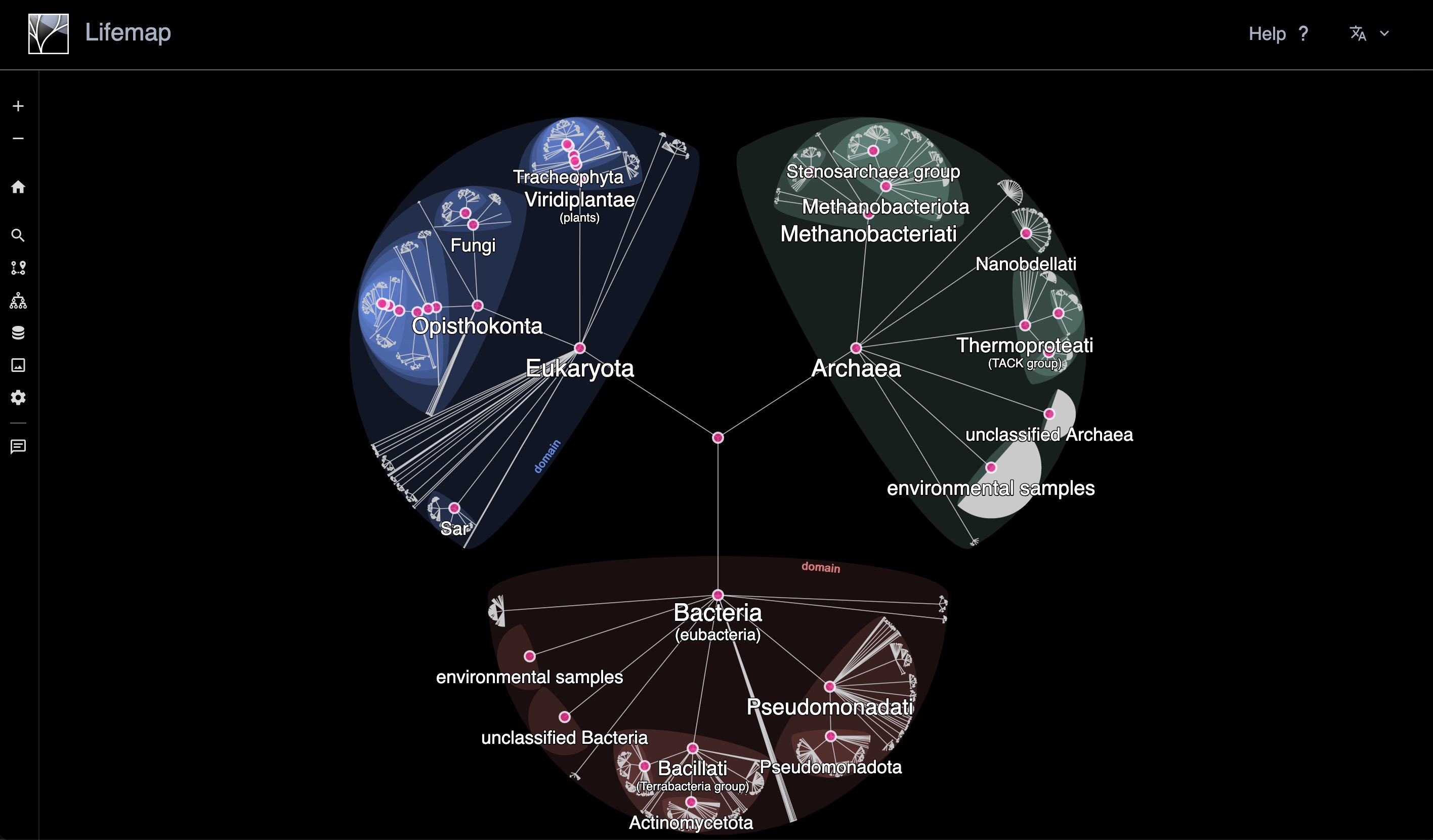
All living things are connected, see this in one interactive exploration of the [Tree of Life](https://lifemap.cnrs.fr/), a map of more than two billion species that live on this one planet.
[](https://lifemap.cnrs.fr/tree?efficiency-mode=false)
> Lifemap is an interactive tool to explore the tree of life. The concept used in Lifemap is similar to the one used in cartography with tools like Google Maps© or OpenStreetMap: exploring is done by zooming and panning. The current tree contains 2 305 164 species: 13 780 Archaea, 594 984 Bacteria and 1 696 400 Eukaryotes. It is based on the taxonomy published by the NCBI (public domain) and updated regularly.
>
> All the nodes in the tree are clickable. It displays information (description and picture) concerning the taxa (retrieved from the Wikipedia page, Lifemap by [Damien de Vienne](https://lbbe.univ-lyon1.fr/fr/annuaires-des-membres/de-vienne-damien)/ CNRS is licensed under a Creative Commons Attribution-NonCommercial 4.0 International License.
There are many ways you can explore this map, by zooming in from the full map down to find a particular species of bacteria, plant, or roam to find even somewhere, in there, an curious one such as [human beings](https://lifemap.cnrs.fr/tree?tool=search&tid=9605).
Or if you know a particular genus, like one of my favorite cacti that grows in my yard, [_Escobaria_, you can search and find it in the map](https://lifemap.cnrs.fr/tree?efficiency-mode=false&tid=130118).
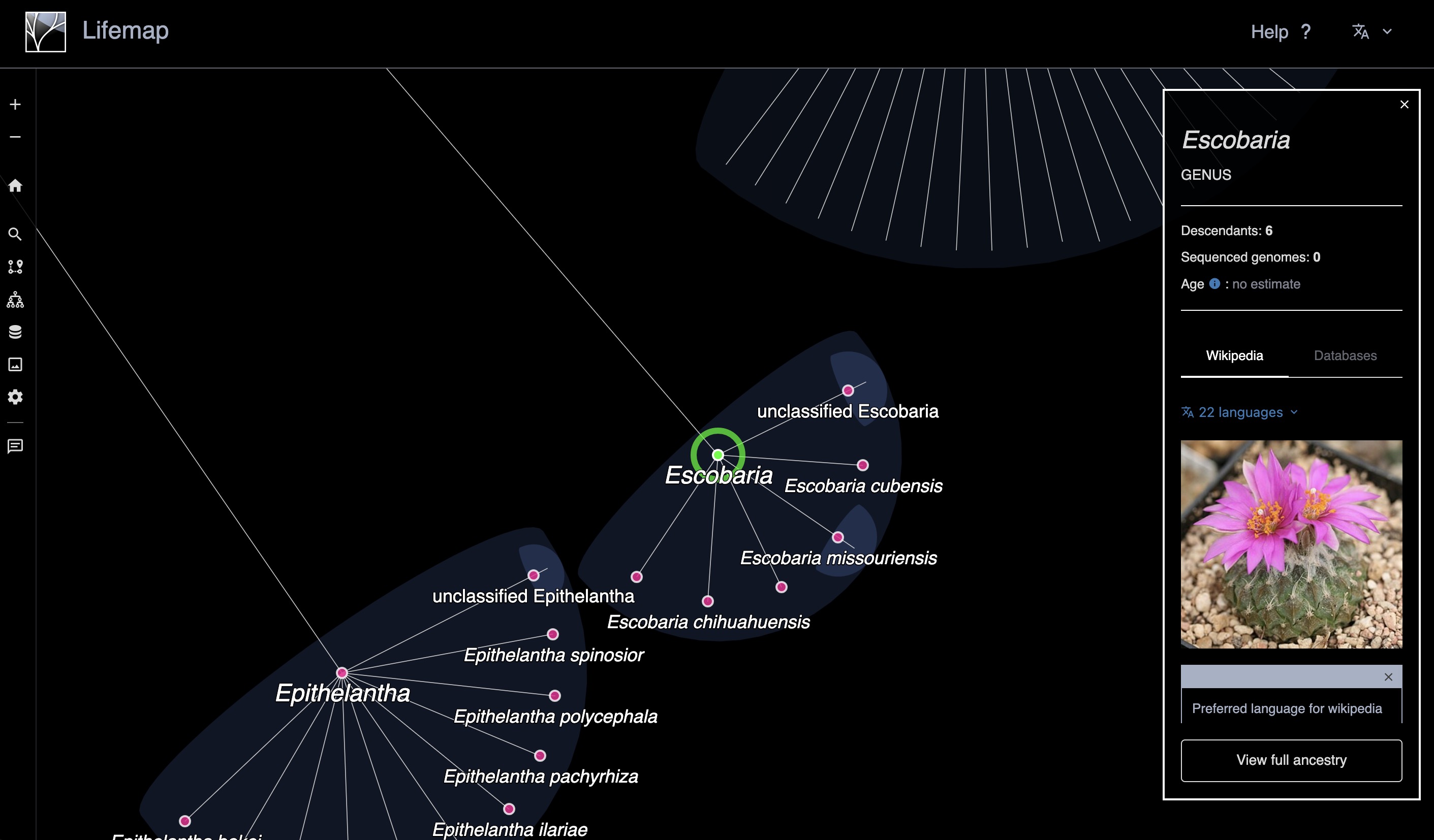.
_Then_ watch what happens when you click [Full Ancestry](https://lifemap.cnrs.fr/tree?efficiency-mode=false&tid=130118&ancestor=130118,0&tool=ancestor).
Explore the LifeMap and share something interesting that you discover.
---
### Author:  [@agrey](https://connect.oeglobal.org/u/agrey)
#### Post date: [July 6, 2026, 9:39pm UTC](https://connect.oeglobal.org/t/monday-connect-explore-the-tree-of-life-with-lifemap/9147/2 "2026-07-06T21:39:29Z")
This reminds me of an old Encarta CD-ROM series that I had when I was growing up. It had a map that was really similar to this.
---
### Author:  [@cogdog](https://connect.oeglobal.org/u/cogdog)
#### Post date: [July 6, 2026, 10:29pm UTC](https://connect.oeglobal.org/t/monday-connect-explore-the-tree-of-life-with-lifemap/9147/3 "2026-07-06T22:29:40Z")
Encarta! CD-ROM! Oh the flashbacks. Okay I grew up with just World Book Encyclopedia as my reference),
This LifeMap is all made from public domain data at the [National Center for Biotechnology Information](https://www.ncbi.nlm.nih.gov/).