Not enough can be ever said about the contributions of MIT to the open movement, from OpenCourseware to Open Learning. They are after all, the reason for OEGlobal being here.
Maybe it’s been there for a while, but I just came across the public facing access to everything openly shared via Learn with MIT “Lifelong Learning. The MIT way.” You can find learning materials of interest on the front, browse by topic, and search through the vast collection of courses, programs, and learning materials (aka OER).
All the usual stuff. But they also have Ask TIM, a front end AI supported search mechanism- and if you wondering about who TIM is, well it goes back to 1914..
I gave TIM a spin. Since I have been using a range of tools even before AI became te rage, I’ve always been curious how tools are able to transcribe audio to text and also translate. Typically the answer, when you look is really fuzzy reference to AI. So I asked TIM
I want to learn more about how machine language technology transcribes and translates audio
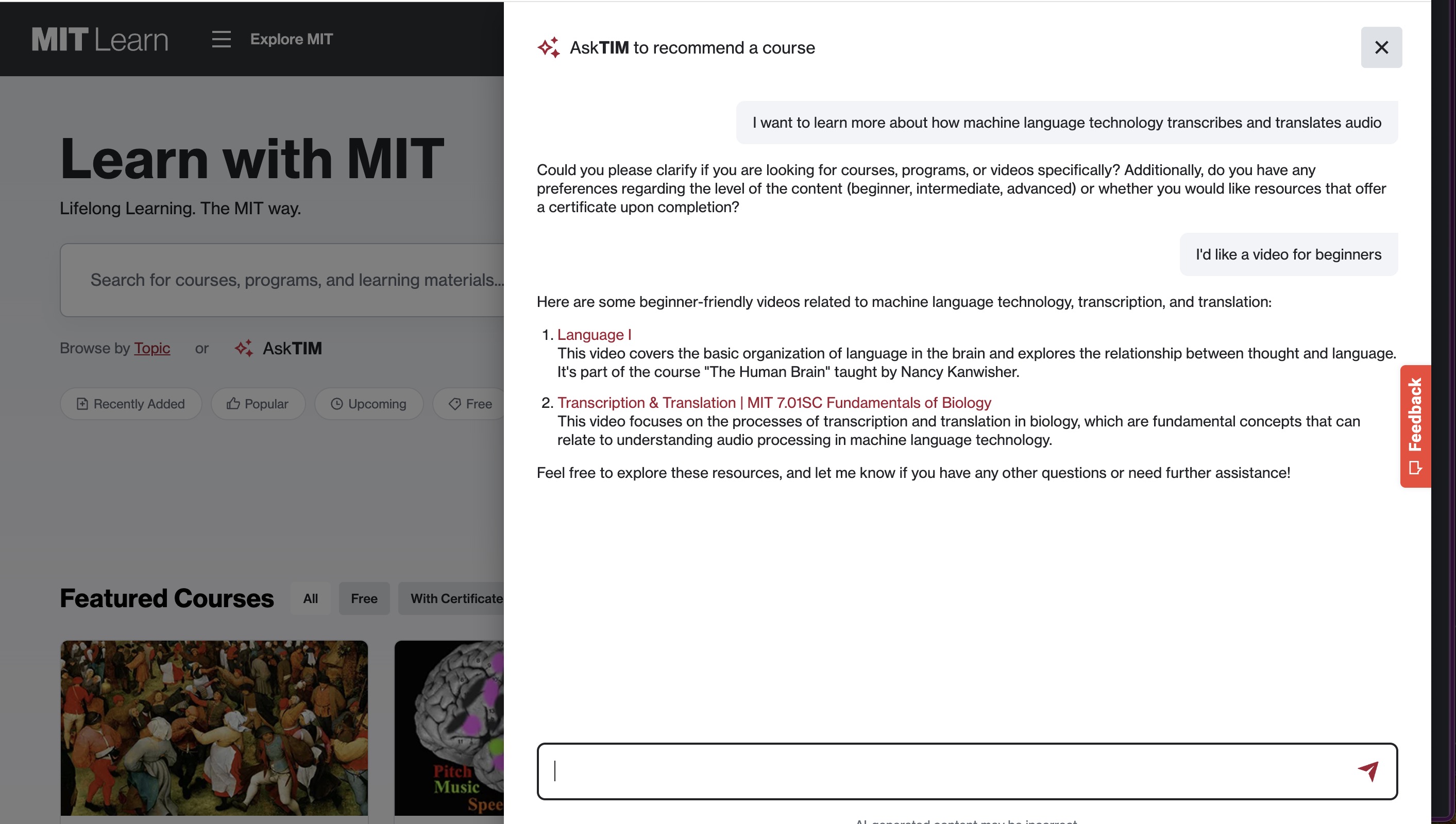
TIM wanted more specifics, “Could you please clarify if you are looking for courses, programs, or videos specifically? Additionally, do you have any preferences regarding the level of the content (beginner, intermediate, advanced) or whether you would like resources that offer a certificate upon”
I asked for videos for beginners, and got two results:
- 18. Language I “This video covers the basic organization of language in the brain and explores the relationship between thought and language. It’s part of the course “The Human Brain” taught by Nancy Kanwisher.”
- Transcription & Translation | MIT 7.01SC Fundamentals of Biology " This video focuses on the processes of transcription and translation in biology, which are fundamental concepts that can relate to understanding audio processing in machine language technology."
This was just a quick test, and I have yet to watch the videos.
But I’d be curious to see what others come up with, give Ask TIM a try and share what you discover.
Also, I know nothing about how it works, what the technology is, but am counting on our MIT colleagues to answer any questions there. And absolutely, this is just an early taste of what is in store a year from now when OEG to MIT October 7-9 for the 2026 OEGlobal Conference (and yes, as it says, this will be both in person and online).