Day 1 Panel Discussion and the "Big" Questions

In today’s session, the launch day of the OEGlobal Tour, we assembled a panel of open educators from across the Middle East, Asia, and Oceania. That’s much to cover!

Our panelists include:

  • Marian Wan, @wanhsu1234 TOCEC, Taiwan, OEGlobal Board Member
  • Haruo Takemura, Osaka University, Japan
  • Katsusuke Shigeta, @Katsu Open Education Japan
  • Martin Dougiamis, @moodler Moodle, Australia
  • Mojito Jione, University of the South Pacific
  • Fawzi Baroud, UNESCO Chair OER, Lebanon
  • Saida Affouneh @Saida An-Najah National University, Palestine

And now look at the “big” questions we put on the table for them:

Four Large question marks each cut out of paper embossed on shapes of thought bubbles, spread on a table over an open blank notebook with a pen.
2 Décors En Forme De Coeur En Bois Blanc Pexels photo by de Leeloo The First shared under a Pexels Free License

  • Is Open Education still relevant in your country or region?
  • What are the Open Education Opportunities in your country or region?
  • What are the Open Education Challenges in your country or region?
  • What is the Future Direction for Open Education?
  • What do you think the impact of AI will be in your country or region?
  • What are the research priorities in the field? Share any gaps you can see.
  • What is being done at the moment? Share the practical steps that have been taken.

We might need a 9 day zoom session just to begin answering them-- and in our panel discussion today we will attempt to start with responses to hopefully three of the questions. But that is why we have an asynchronous discussion place here.

Now we invite you to pick one (or more) to add your replies below. And maybe we can extend this conversation a long time.

Please jump in anytime.


OEGlobal Tour 2025 Navigation

:spiral_calendar: General Calendar plus links to daily events

:arrow_up_small: Main Space virtual lobby for the Tour
:arrow_forward: Welcome Greeting and Meeting
:arrow_forward: Tour Information How to Participate, What to See and Do

:arrow_forward: Day 1 Middle East, Asia, & Oceania
:arrow_forward: Day 2 Africa and Europe
:arrow_forward: Day 3 Latin America and North America
:arrow_forward: OE Award Winners Ceremony

2 Likes

Taiwan aspects: Asia_panel_MarianWan_20251014 - Google Slides


:backhand_index_pointing_up: you can access the recording of this section here.

Here are just a few of the standout quotes I could capture, please add the ones that inspire you …

Why Open Education is still relevant

Palestine … “We look at Open Education as a seed of hope. It is a survival strategy. When all the education system is destroyed, learning will continue through Open Education. It is a survival strategy and a way towards freedom.”

Fiji … “When it comes to access and equity, even the most marginalized people can get an education. We are a small country with limited access to resources.”

Australia … “Students are struggling with debt, and open education is a way to support them.”

1 Like

Watch it again here: https://www.youtube.com/live/xl6mepD7NuE

:backhand_index_pointing_up: Access the recording of this section here.

Here are some of the links shared during the session:

Igor Lesko:
Here is more info about the OER Collective that Martin has just mentioned: https://oercollective.caul.edu.au/

USP (Fiji) also has an institutional OER Policy: https://policylib.usp.ac.fj/form.readdoc.php?id=736

Martin Dougiamas:
I have in mind a universal role-play simulation environment that can cope with any scenario, but it would be great to understand the ones you’ve got, since the system should know about the ones that work best and help teachers select them. This will be a free activity plugin for Moodle users.

Some other techniques that work well:

  • Socratic Tutor- Answer questions with better questions
  • Practice Partner - Endless personalised problems to learn by doing
  • Instant Feedback loop - Immediate non-judgemental non-fixing guidance on student work
  • The Scaffolding Tool - Handling distracting mechanics at lower levels
  • How We Could Build a Better Future for Creators in the Age of AI

Muawya Hussein:
I think one of the most challenges in our region is government and Traditional Universities in Accrediting Open Education

Alan Levine:
Offline Internet Consortium https://offlineinternet.org/

Isla Haddow-Flood:
Here is another offline platform: https://kiwix.org/

Abdalla Elgyli:
You are kindly invited to visit our official website at www.mdl.edu.sd.

Igor Lesko: This resource may be helpful or serve as an inspiration to address the challenge you describe: Valuing OER in the Tenure, Promotion, and Reappointment Process: Valuing OER in the Tenure, Promotion, and Reappointment Process – Simple Book Publishing

Mojito Jione:
USP Open Pasifika Site for Open Course: https://openpasifika.usp.ac.fj

Tony Mays:
Agree with Martin on the need to get teachers involved in acknowledging sources and making the final decision on quality: Teacher in the Loop AI (TiL-AI): A Strategy for Empowering Educators in Developing Countries through OER Adaptation | Journal of Learning for Development

Martin Dougiamas:
I want to just point out, just in case someone wasn’t aware, that AI also has many open alternatives … there are hundreds of available AI models you can run locally on your own hardware without internet. We are not forced to be reliant on Big Tech for this.

Igor Lesko
Please have a look at some of the projects/courses through the Open Education for a Better World Initiative that we support: https://oe4bw.org/projects/. There may be some useful open sources on trauma-informed pedagogy. Also, peace education.

Nadine Aboulmagd:
Totally agree with you @Fawzi Baroud about giving students more agency and stronger voices.

Prof.NAHLA SULEMAN
Great topic needs a conferance to share more outcomes point.for this point of views I would like to add my voice to what Mr.Martin state professors teachers and educator should sign all content that being generated by AI that means textbook has to be there that what now elymezab sudanese digital library is being through specially for all levels from KG1 upto Phd higher education research. Ethical points crisis experience in Palestine all global leaders.

Something I’ve become very interested in recently in my area is the concept of clubs as learning places.

Martin Dougiamas:
I see the future of open education in these, basically we use technology to bring lifelong learners together around specific hobbies and practices face-to-face in local areas.

Abdalla Elgyli:
Refer to the question :
The future of Open Education in Sudan holds promise but faces major challenges.
Ongoing conflict has displaced millions and disrupted traditional education, leaving over 14 million children out of school. However, international support—like UNESCO’s $400 million transition plan—offers hope. Expanding digital infrastructure, training educators, and developing localized open platforms could make education more accessible, especially for displaced communities. With strategic investment and collaboration, Open Education can become a powerful tool for rebuilding and inclusion in Sudan.

Sarah Steen:
Open Education Down UndOER: Australasian Case Studies - Open Education Down UndOER: Australasian Case Studies – OER Collective

Julia Dehm:
You can access Becoming a Climate Conscious Lawyer here Becoming a climate conscious lawyer: Climate change and the Australian legal system, eBureau, Publications, Featured, La Trobe University
The Climate Conscious Lawyers website is https://climateconsciouslawyers.com/

Irene Maweu:
Equity Unbound: Stay tuned and sign up to our mailing list: Subscribe – Equity Unbound
For a snapshot of EqU activities, live session recordings, publications, talks and podcasts: Snapshot – Equity Unbound
Follow us:
BlueSky @equityunbound.bsky.social
LinkedIn: Equity Unbound | LinkedIn

:backhand_index_pointing_up: You can watch the recording of the discussion and answers to this question here.

@Saida shared a PDF version of her published article

Affouneh, Saida & Khlaif, Zuheir. (2020). A Hidden Dream: Open Educational Resources. 10.1007/978-981-15-4276-3_4.

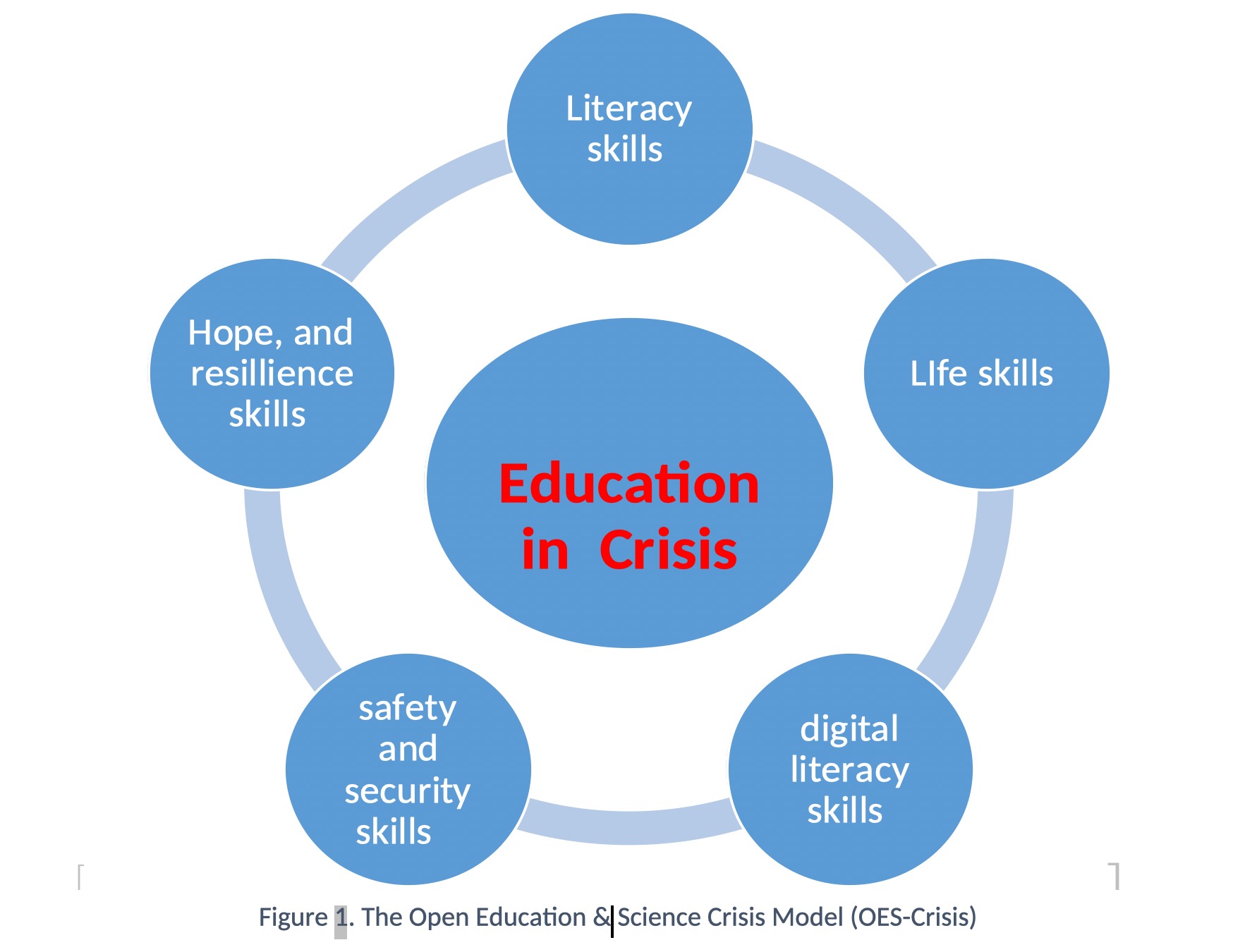
In addition, during the panel she mentioned her paper that included a model of Open Education in times of crisis, which she has also shared with us:


Figure 1 from Burgos, Daniel & Saïda, Affouneh. (2022).

BURGOS-AFFOUNEH-Future of Open Education-04 (1).pdf (129.7 KB)

Burgos, Daniel & Saïda, Affouneh. (2022). Open Education and Open Science in contexts of crises. Education Ouverte et Libre - Open Education. 1. 10.52612/journals/eoloe.2022.e11.750.

Open Education and Open Science are powerful tools for Education. They can provide content, access, means and collaboration to anyone interested in learning, worldwide. Further, in contexts of crises, they increase their impact and outreach. There are many types of crises, from natural ones, such as earthquakes or hurricanes, to man-made produced, such as wars, occupations, migrations or financial recessions. In these cases, an open approach to use, re-use, share and produce, guarantees education and science, even in the hardest conditions. In this paper, the authors present an overall approach to openness and crises, and how to implement them based on competence frameworks. As a specific resource, the paper introduces the Open Education & Science Crisis (OES-Crisis), which is based on five components in the form of skill-sets: 1) literacy skills, 2) digital literacy skills, 3) safety and security skills, 4) hope and resilience skills, and 5) life skills.

During the panel discussions @moodler made the case for more use of “local” LLMS, e.g. what one could run on the desktop. When asked for an example, he recommended Ollama.

This reminded me of a post by my colleague Harper Friedman at BCcampus, where he outlined in a blog post very detailed step by step guide to using GPT4ALLl

His reasons for documenting this option include that GPT4ALL

  • Is an open-source software,
  • Emphasizes privacy,
  • Can interact with your local documents,
  • Quick to install (10-15 minutes),
  • Easy to use and is virtually “plug-and-play”,
  • Easy to customize the System Message of the model, which tells the model how to behave and interpret the conversation.

I have not tried this yet, but Harper’s documentation is very thorough.

1 Like