Do Today's Daily Create: #tdc5165 #ds106 #oeweek26 Curaturae: A sentence from an OER Written With Open Access Images

This Open Education Week is going by so quickly, here is our fourth daily create offered as a special activity for the week. Do five, do one, or just invite someone else to try.

Today we ask you to explore Curaturae a fascinating experimental project from the Smithsonian subtitled Write With Open Access. It presents a blank writing space. As you type or paste in text, it dynamically analyzes the words to in real time display open access images correlated by keywords.

Find a sentence or two from your own or a favorite open educational resource, and enter it into Curaturae (it supports 10 different languages). Share what emerges. Maybe tell a story that connects the images. Let your imagination go wild.

For this example, I copied into Curaturea a sentence from the UNESCO Recommendation on OER.

Text on left, many words highlighted Recognizing the leading role of UNESCO in the field of education and in the achievement of Sustainable Development Goal 4 (SDG 4), which calls for the international community to ensure inclusive and equitable quality education and promote lifelong learning opportunities for all. on the right are various icons of images, portraits, posters, landscape paintings.

Sentence ftom the UNESCO OER Recommendation entered into Writing with Open Access

As far as the story… hmm, the central image tied to the word development is surrounded by a tapestry of people and places representing the international community.

Give it a try! If curious, read more about How Writing with Open Access Works.

Can you do all five Daily Creates This Week?

Five, four, three, two, one is all fine!

March 2-6 is the annual celebration of Open Education Week, if you have not heard about it, check out everything happening this week with a daily schedule of stuff to do. And it’s taking over the Daily Create for five days.

I am adding this week’s OEWeek challenges as an activity posted to the Open Education Week collection. If you are a regular Daily Creator you know how to reply to this Daily Create in Mastodon. But you can post your photo anywhere and share a link in the comments below, or even better, you can reply to this challenge in the OEG Connect Activity Space. Or just do them for yourself! There are no rules in the Daily Create Club.
Yes, this one might be a bit bizarre, but I added it mainly for the wonderful bit of openness demonstrated by the Writing with Open Access created at the Smithsonian museum.

For a bit of text from an OER I reached for a long favorite, the guide to winter plant identification Buds, Bark, and Branches by Juila Alards-Tomlin at BCIT (listen to our podcast with the author who was recognized with 2023 OE Award for Excellence for this OER).

I scrolled to the entry on page 45 for the Common Snowberry, a shrub common here in Saskwatchewan.

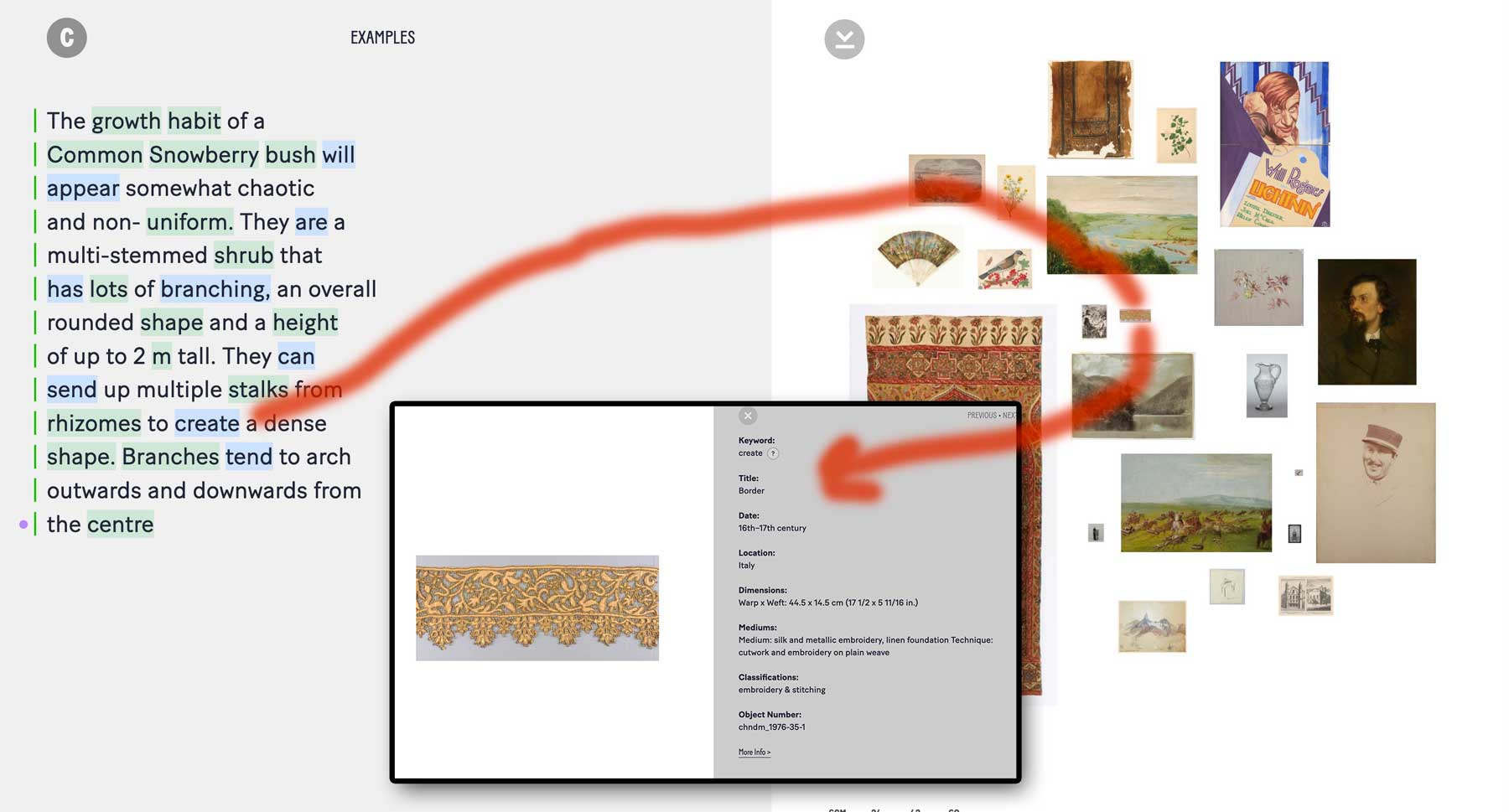
Common Snowberry bush will appear somewhat chaotic and non- uniform. They are a multi-stemmed shrub that has lots of branching, an overall rounded shape and a height of up to 2 m tall. They can send up multiple stalks from rhizomes to create a dense shape. Branches tend to arch outwards and downwards from the centre

The words associated with them by keyword in the are hardly literal in the Curaturae site. Some are, like “Will” connects to a poster of Will Rogers, but why does “lots” connect to a 1871 portrait of George Inness?

I pulled out a detail for the association with the word “create” that leads to a 16-17th century bit of Italian embroidery.

It’s a most curious bit of Curaturae:

I bet it took me longer to write this post than to do this Daily Create. Oh well, I think it’s important to narrate one’s own methods, at least more than just clicking like buttons in LinkedIn.

One more Daily Create to go this week.

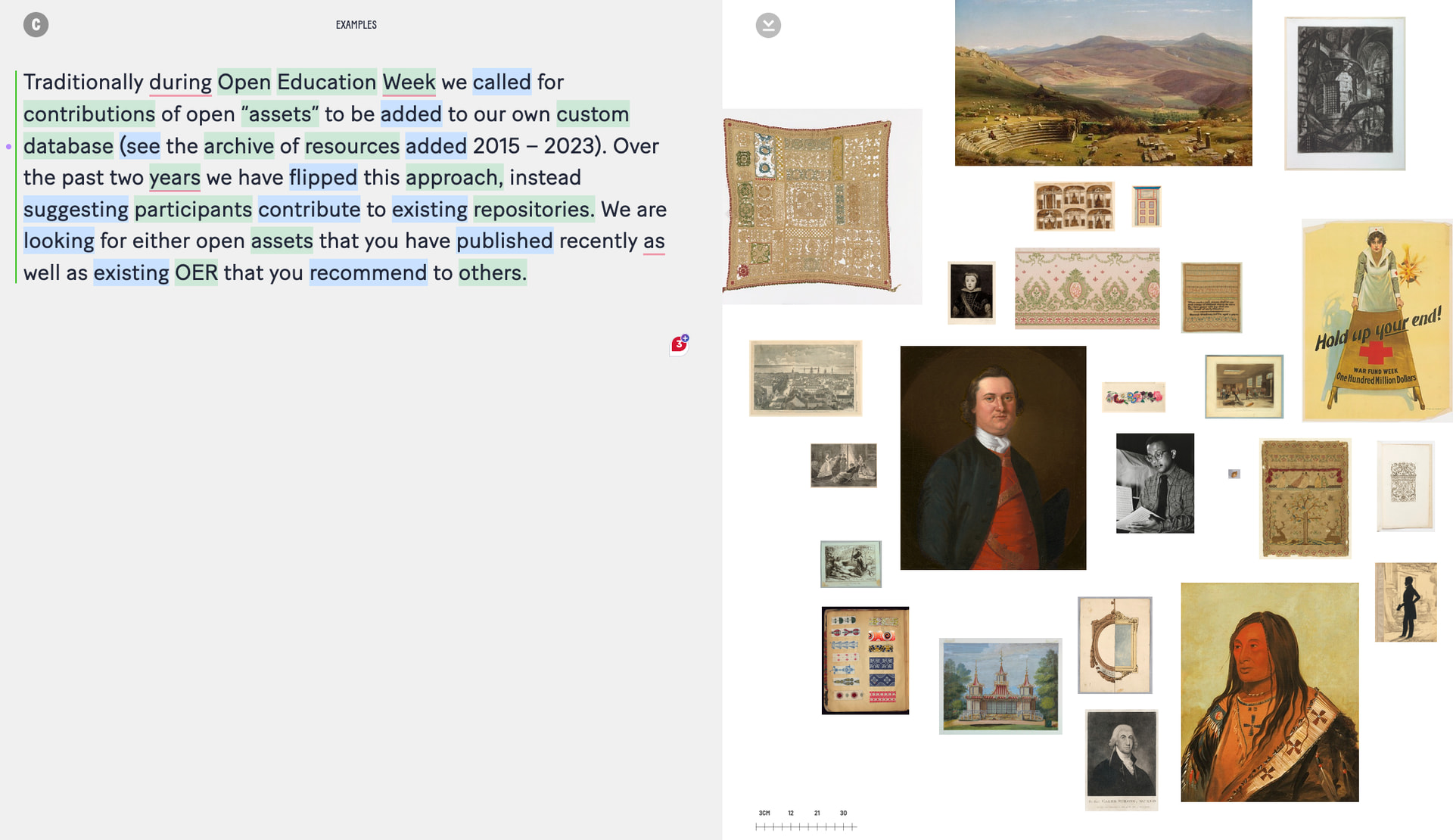
I cheated and put in a sentence from the OEWeek website about Open Assets … these are the images that came up … some make sense, some are a bit strange (that’s part of the fun!). I really like the “Hold Up Your End” poster, and the silhouette …

1 Like

I agree in that the results are far from literal and I would guess meant to have us think about metadata and its relationship to more general text forms.

Or better it’s a means to draw people in to exploring the assets from multiple art and museum collections.

Thanks for playing every day!