Note I did not title this topic, “Have You Heard of Wikipedia?”. But have you ever listened to the sounds of it growing?
Perhaps one of the most brilliant things I have ever come across is Listen to Wikipedia. To me this is an most impressive things to show people new to Wikipedia, to get a sense of how alive it is. Take a few minutes and experience a visual and audio experience (rather accessible?)
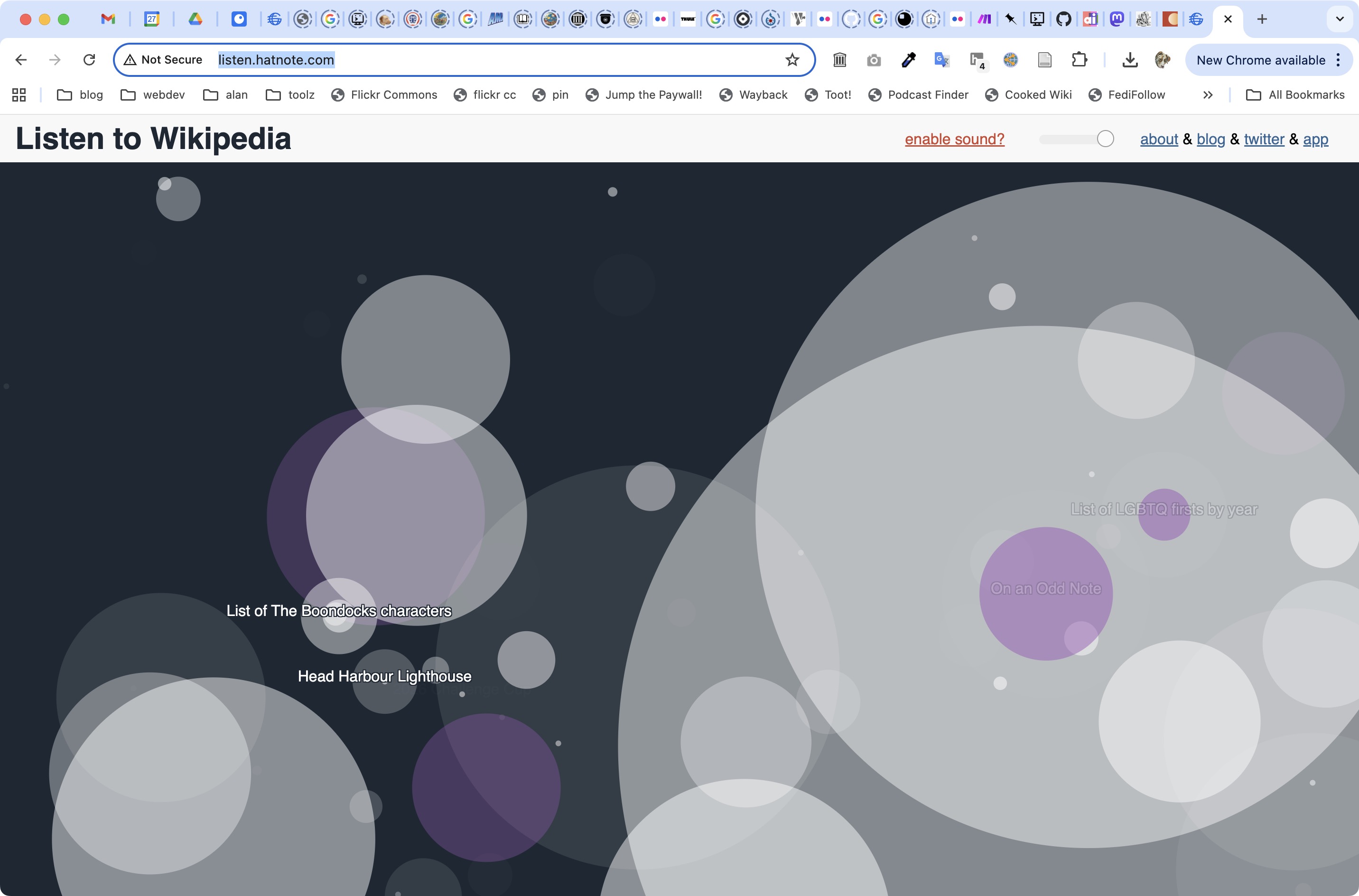
You are seeing and hearing (if you enable sounds) what is being changed, added to Wikipedia right in the moment. It gives such a meaningful impression with how much is happening all the time on Wikipedia.
Listen to the sound of Wikipedia’s recent changes feed. Bells indicate additions and string plucks indicate subtractions. Pitch changes according to the size of the edit; the larger the edit, the deeper the note. Green circles show edits from unregistered contributors, and purple circles mark edits performed by automated bots. You may see announcements for new users as they join the site, punctuated by a string swell. You can welcome him or her by clicking the blue banner and adding a note on their talk page.
It can make for some soothing background music to work by (mine is on right now). You can scroll down and see a log of the changes as they happen, but even more impressively, you have options to hear the sounds of edits to the other language versions of Wikipedia.
I used this a long while ago in a session for a project with a group of educators in Guadalajara, Mexico in an effort to introduce that “there is much more than the encyclopedia”.
This first demo gives that expression. But what we wanted to do in an attempt to create interest in becoming active in Wikipedia, was to contrast the experience of the changes happening in Spanish Wikipedia - listen to the difference. You can see/hear regular activity, but the music is more subtle, less activity.
I thought of Listen to Wikipedia recently in a few conversations about the challenges and needs for more Arabic language OER. I am curious if there us use/interest for educators in Wikipedia Arabic (still interested). Listen to that sound.
There is even less sound. But there is sound. Occasional pulses. I am listening now. Oh, two more.
I find Listen to Wikipedia an amazing capability built on the openness that emits from Wikipedia itself (feeds of activity) For a different experience that also leverages this, see Wiki Asteroids.
But I get curious when I find an interesting web resource, so when I see a URL like http://listen.hatnote.com/ I get curious… what is hatnote.com what else is there? And off I go to explore (maybe you will to) – it reads
“A collection of perspectives on wiki life.”
I find The Weeklypedia an email list you can sign up for
Join a list to receive a weekly email with the top twenty Wikipedia articles and top five Wikipedia discussions from this weekk, available in English and more languages.
And a simple link to https://seealso.org/ unfolds an entire universe of curiosity calling visualizations curated by whomever is behind Hatnote.
Me, I am always curious about the people/person behind a web site. Thus I am now hasing the ourstory link. It’s a blog called Sedimental (my geology background picks up on that wordplay) or “Thoughts on FOSS and fintech, layered by Mahmoud Hashemi” Here is one person’s open story:
Every day I wake up happy that one of my favorite websites, Wikipedia, is free, open, and well-supported. My wiki-timeline summarized:
- 2003: First memory of using Wikipedia, as a high school student in Iran.
- 2007: First time setting up MediaWiki, the software that runs Wikipedia.
- 2012: Attended my first Wikimedia Foundation hackathon, in San Francisco.
- 2013: Founded Hatnote, with Stephen LaPorte. (Follow us on our blog or Twitter.)
- 2019-: Still going strong, with over 2 million satisfied users of Hatnote projects listed below.
Today, I am still a student of Wikipedia. I use it dozens of times a day, and you’ll see it cited throughout anything I write. I also continue to proudly host and administrate MediaWiki, though my extension-writing skills have languished. But this is mostly a story about building on Wikipedia: the story of Hatnote.
This is remarkable all generated by a high school experience in 2003 of a student in Iran. Look what has flowed from that.
I find this experience is incredibly reassuring as the current state of heaviness around technology focuses on what large corporations are doing and the effects of the embracing of automated machinery. Indeed I might have gotten an answer if I asked an LLM “Who created Listen to Wikipedia” but it is not nearly as fulfilling as link navigating it myself and g finding Mahmoud’s own story as one human.
Okay, I just wanted to share a neat resource and I fell down the curiosity hole of the internet. It is still out there if you follow links. So please, I implore. if you are putting content in the web make use of generous hyperlinks. It’s not a web without them.
Take a few moments to listen with a sense of wonder to WIkipedia. I have just heard the changes to articles on Network effect, 2026 PDC World Masters, Sir Henry Bowles, Shima-san 1st Baronet, The Prophecy of Dante, Cold fusion, Eurostar, Val-des-Prés - that was in 30 seconds.