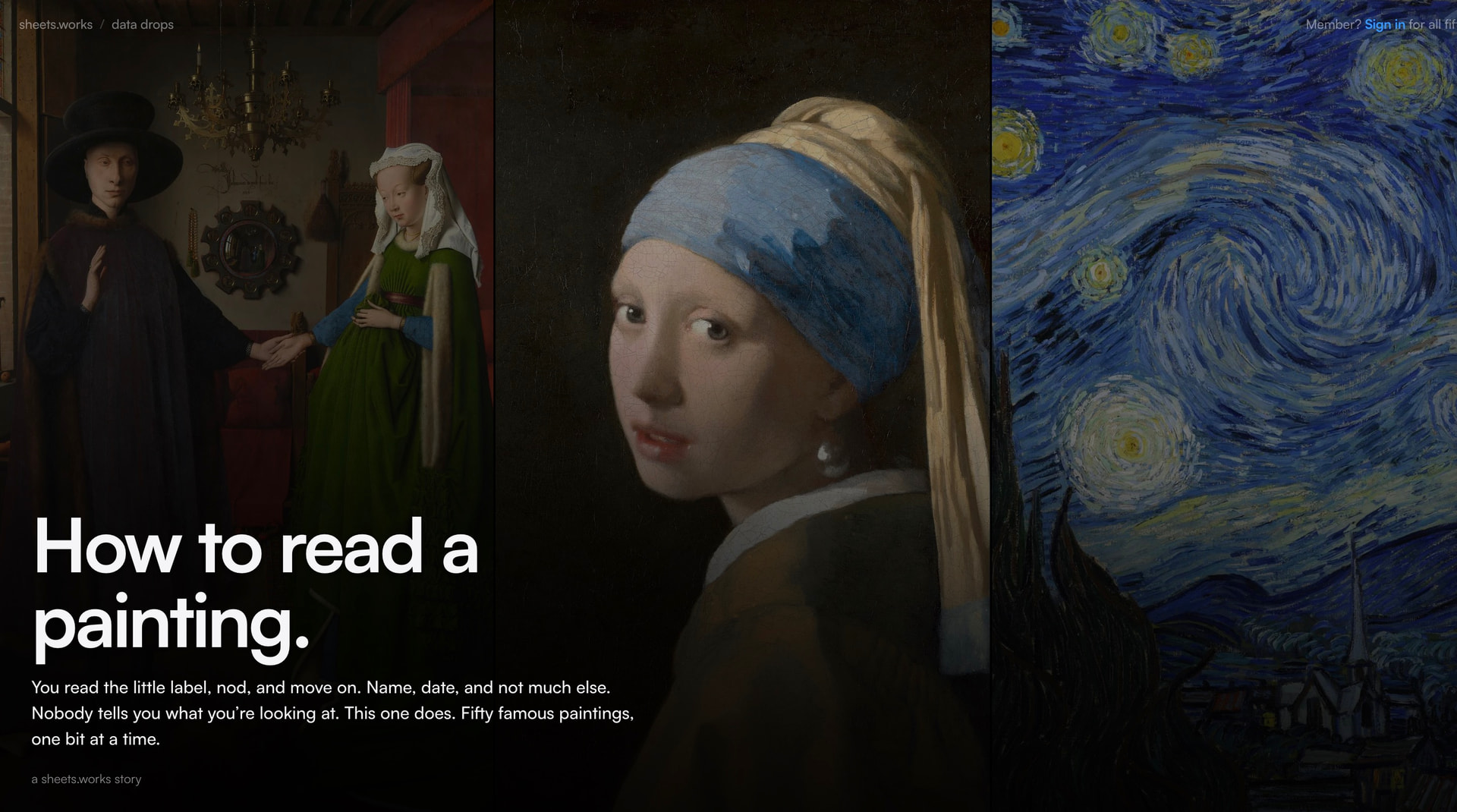
I am no art expert, and admit on museum visit wondering if its better to read the label first and then examine the art, or do my own attempt at understanding before jumping to the “answer”. There is no right way, right? But how do you go about trying ti understand a painting (and remembering from my undergraduate Art History class how much was not readily apparent without a guide.
From the gallery of 50 paintings you can get a guide that zooms in and explains a detail in 10 steps, and then offers you a chance to explore on your own. I like how the site defines a structure and shows it in action:
what is this the name, the painter, the year. One sentence, out loud. first look what’s there before deciding what any of it means. who is here count everyone. People, animals, reflections, backs of heads. what is happening one sentence you could defend while pointing at the paint. the objects pick two things that look deliberate and ask what job they do. how it’s builtwhere does your eye land first, and where does it go next? when and wherewho could afford this, and who was meant to see it? the bit that sticks the one thing you’ll still remember next week.
This is a data visualization from a site called sheet works (they do consulting on built spreadsheet based tools and systems)- I get them by email as the data drop " We pick one thing and take it apart with data. A film. A sport. A market. Some strange corner of the internet."
Note that you can explore 3 of the 50 paintings for free before they ask for a subscription, but I find it is a clever and well structured method for helping understand art.
Pick a painting and share what you discover their the guide.
Me, I enjpyed a detailed walk through of elements in Van Gogh’s Potato Eaters, learning his whole focus was the detail of the hands.
I don’t see why not though maybe the questions would be rewritten(?). Perhaps try it on a few of these
Or some other collection. Perhaps some would argue that more goes into a painting in that it is done over time and even parts are redone? Still a photograph is not just a snapshot.
So what would ask a viewer on How to Read a Photograph? Maybe I can coax @Jonathan into a reply.
One of my favorite ways to explore art is through Exhibition on Screen. It’s less about reading and more about learning but I really enjoyed watching Klimt & The Kiss (with its deeply poetic music) and Sunflowers (about van Gogh) in a local cinema.
NB: You want to watch these on a bright screen in 4K. Some of these seem to be available through streaming packages – haven’t tested these (the selection is limited by region, like Netflix) but worth a mention for those who want to binge watch…
Thank you Alan - being invited into a conversation with you and Mr D is like 2014 all over again. We spend so much time unpacking photographs on our courses, and quite quickly we learn their meanings are seldom, if ever, fixed. Context is everything. From the moment of capture, through edit, to publication and finally to reception and interpretation.
Reading photographs, especially out loud in a group most people find intimidating so we try to remove that. I ask people to imagine they’re on a radio show so the audience can’t see the image we’re talking about. Then I ask them to imagine the audience are aliens who are blind. Everyone but the reader closes their eyes and pictures what’s described. People ask questions to better “see” the image in their mind’s eye
But here’s the thing - you have to presume nothing and describe EVERYTHING. Starting with the most basic …. I’m looking at a black and white image which is 6x9 portrait dimensions…. Etc etc
Then when you’ve exhausted everything evidenced, describe how you feel. The room describes how they are feeling.
Then we draw connections between what you see and how you feel. Why is it having this effect on you? Would these signs and signifiers within the image have the same effect on others? Usually we have a fairly diverse crowd and this process of describing, decoding and understanding affords us to better understand not only how we are being affected, but also how we might leverage this visual language in our own image-making.
I have great fun running this workshop with Joel Sternfeld’s “On this Site: Landscape in Memorium” book.
We go once through and after describing the images and declaring whether the pictures are good or bad, we go back through them again. But this time I read the titles and captions.
It’s a class no one ever forgets.
Ps. Just to add - it occurs to me that paintings aren’t “used” quite as photographs are - they may have been historically, but not now (I’m coming from a photojournalist position), photographs (let’s leave the digital image/AI versus photograph aside) are used as a visual language to affect attitudinal shifts and behavioural changes. So they mean stuff to us (although people like Fred Ritchen argues they no longer do - like paintings don’t anymore ).
Thank you JW for chiming in with such practical approaches from your teaching photography experience and in seeing Joel Sternfield’s web site on his book I easily understand why this was a memorable workshop.