Over the years I have seen many efforts to combine the mapping capabilities of the web to show locations of plot event in works of literature, a means to explore books by where scenes take place. And indeed PlotLines is yet one more, but there seems to be a compelling set of featured working inside of the site.
PlotLines takes out-of-copyright classics and draws their characters’ journeys on a period map. Pick a book, press play, and the whole cast moves at once - or follow one person and let the map travel with them. Hover any stop and you get the place as the text itself names it, with the line that puts them there.
The maps have an antiquate look, and for the 43 titles (yes, Western Literature), you can explore characters, locations, plot points by where they occur, but you can also see it played out as an animation. Here is an early part of Don Quixote on Plotlines where Don Quixote and Sancho are on their way to Campo de Cristina
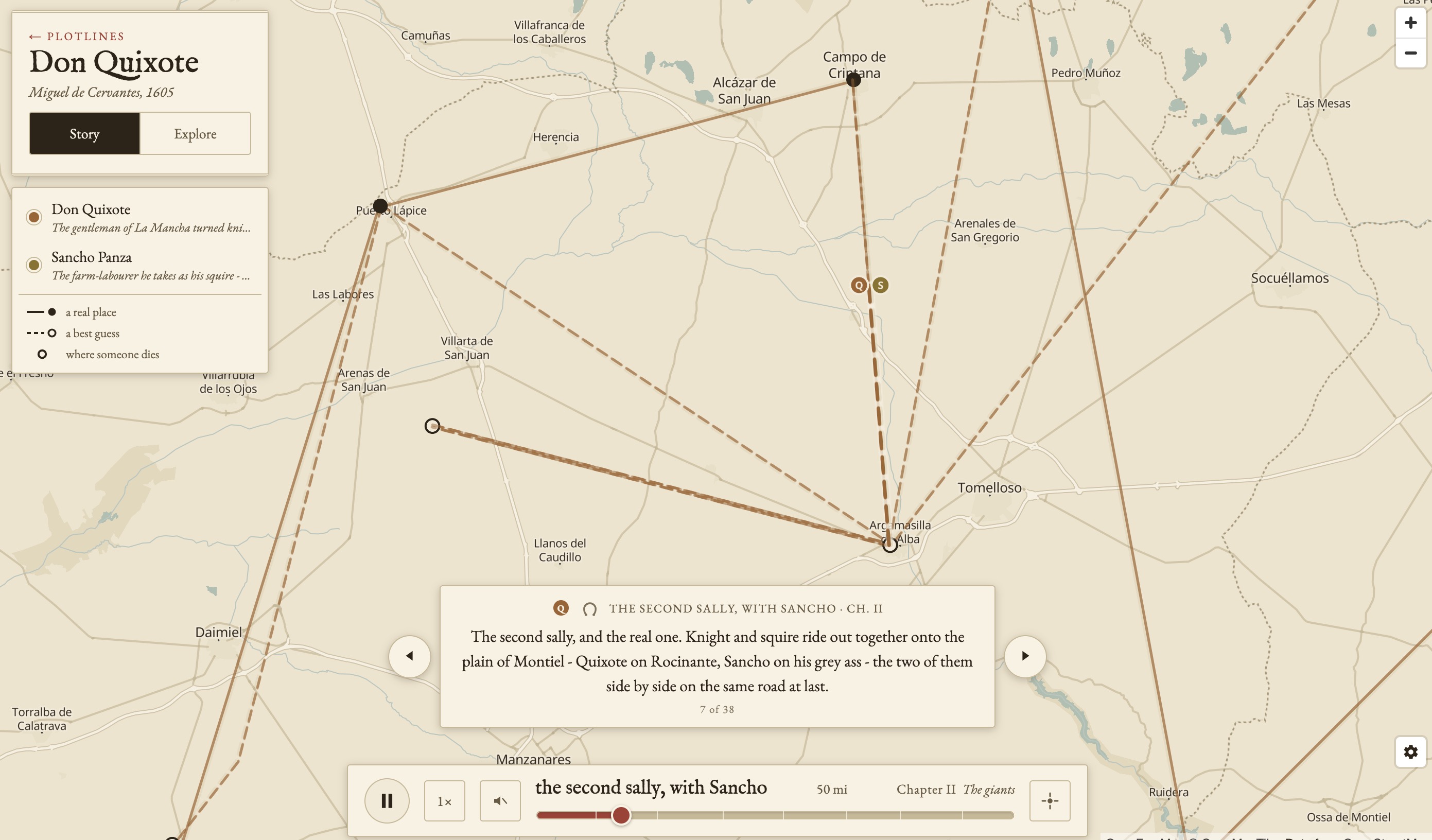
The “bookshelves” can be sorted by author, title, distance traveled, and one can also explore an atlas, a map of all locations across the titles.
The sense is that this site is riding on a fair amount of data, and includes a fascinating description of how it was made, indicating a fair bit of Agentic AI but also constrained by what the creator of the site describes as “gates”, and as such, there is no AI at all in the final product.
Here is the strange thing about PlotLines: the site you are reading has no intelligence in it at all. It is a set of data files and a small program that draws them on a map - nothing is thinking while you watch Phileas Fogg cross the Pacific. All of that happened earlier, in the workshop, where each book is put together by a short line of agents and gates before it ever reaches the shelf. Agentic to make; dead-static to read. This is that line.
It’s quite a story in itself- explore it all. at https://peter-guillam123.github.io/plotlines/ and for those interested in its mechanics, explore more on GitHub https://github.com/peter-guillam123/plotlines