The OEGlobal team is deep in the planning stages of the October 2026 OEGlobal Conference, which is looking to be very vibrant (I may overuse the adjective). From the beginning, a hybrid format is a goal, but what does that mean? I am trying to stir the pot, and we already have posting using the conference theme Come Invent With us The Hybrid Format.
What does hybrid mean to you? Image searches yield mostly cars, but I was drawn to colorful images of hybrid parrots (sending me down another hole of searching). But, look how colorful Ara parrots are, and maybe both bright and thoughtful looking!

Ara Hybrid Parrot pixabay photo by WikimediaImages (meaning it is likely in Wikimedia Commons) Free for use under the Pixabay Content License
Can you help?
- If you have participated online in a hybrid conference format, what was an example of a conference that provided a meaningful experience? What was it that worked for you as a remote participant? What made it seem less isolated an experience?
- If you have attended in person a conference that had a hybrid conference format, what conference was it and did its offer some experiences that connected you to or at least made you aware of the participants not on site? How did that happen?
All responses are greatly appreciated!
1 Like
@cogdog would you consider posting this to the CCCOER Community Group/Listserv? I know we have a lot of conference-goers there, and I’m intrigued to hear what they might say!
1 Like
Of course! It sure feels swimming upstream to generate responses, but I shall keep on. I loom forward to reading your ideas 
I like what Virtually Connecting used to do to bring online people into hallway-type conversations. I think what made it work for me though was already being acquainted with some of the people. Anything that can be done to foster casual conversation among attendees should theoretically make a conference less isolating. If there was an easy way to wire together a Discord chat with a Zoom drop-in meeting and a ds106radio call-in show you could have a multichannel meetup that people could join in whatever way they are comfortable. But making that work also would depend on having a host who’s good at bringing people together.
Anything other than a lot of black boxes with some 12 bullet slide in ppt. Literally anything.
I think there are possibilities for smaller groups to have/do interesting interactions in spaces before and after events. Be that mastodon or google docs or video playlists. How that gets choreographed is the trick.
The best part of the conference was the lunches and drinks. How does that happen in hybrid space?
Take a look at the videos here on Tim Owens YouTUbe channel. Look at the ones from 14 years ago. All kinds of formats. People on couches. Interviews. Weird places. Man, that is the kind of stuff I want to be involed with. Mostly just people playing around. Laughing. Joy. No PowerPoint  Maybe even no point beyond being present in the space. That is the kind of hybrid experiences, conference or otherwise, that I would like to be involved in.
1 Like
Online is always hard but the one time I did attend online to a hybrid session and it wasn’t horrible this is what helped: 1) cameras on, 2) camera on the speaker AND on the in-person audience, 3) strict muting for non-speakers, and 4) no awkward break out rooms. The speaker spoke to us and there was some organic discussion and Q&A time.
It wasn’t ideal but does work out okay with a dynamic speaker. Otherwise, I agree with what @toddconaway said….
1 Like
I want to share a review of one of my employee’s recent hybrid conference experiences.
It worked so well because the goal was to create a unified experience. Not an in-person conference with some virtual offerings, not two separate conferences, but a truly blended experience. Here are some ways they accomplished that:
-
Virtual attendees accessed the conference through a single platform (Pheedloop) that provided the schedule, livestream, chat, a virtual exhibit hall, and session files. This made for a more immersive experience than receiving the schedule via email and clicking on Zoom links all day long – more like being away at a conference. All in-person attendees also had access to the same conference platform.
-
Everyone had access to all sessions. ALL in-person only sessions were recorded and uploaded to the online conference platform after they concluded. In-person attendees could also access virtual sessions. There were many hybrid sessions also.
- Note – because of this I probably attended twice as many sessions as I have from any other conference, virtual or in-person.
-
In Pheedloop, unlike in Zoom, the session Q&A remained visible and could be added to after the session. This made it easier to attend asynchronously when necessary and still connect with presenters and attendees.
-
All the same posters that were presented on-site were also uploaded to the platform as digital files. All the slide decks were also uploaded.
-
Social events united the online and on-site attendees. The conference hired a DJ to perform “dance breaks” that were livestreamed online. The online chat was visible to on-site attendees during the livestream.
-
Conference organizers held a virtual wrap-up session to talk directly to online attendees about the conference experience. They were not an afterthought.
I hope you find some of this useful!
Thanks Paul, indeed Virtually Connecting is/was deeply influential on me as capturing the outside of session hallway style conversations, with experiences of participating remotely and at conferences. I note it has not been active since pre-COVID days, and relied much on self-organization.
It’s something I have tried to infiltrate in our conferences with using Twitter Spaces (wow that was a long time ago) at the 2021 Conference in Nantes (I could not go due to COVID), running some live video streams from our table at OEGlobal 2023 in Edmonton, and trying some DS106 radio at the 2024 Conference in Brisbane.
But indeed it take a clot of coordination on site and off, but I think this is overlooked so miuch with I bring it up, the focus goes to mainly the presentation sessions.
There are even people out there that do KarOERoke
I’m counting on you, Todd! I’d like to organize something systematic for shared notes/highlights from sessions (gone are the days of live blogging, but maybe someone is willing??) as the usual problem at a conference of being able to go to only one session at a time.
Some kind of drop in space is good, and I have note a few conferences that run a morning live radio show.
It gets a challenge as the main conference program ends up densely packed for time. I’d like to have some asynchronous activity as a lead up before, maybe a preconference live session… keep the ideas flowing.
Those are good points, Angie. What’s really lost on most remote participation for a session/presentation is that singular view of a speaker and/or slides, you completely lose the presence of the room.
For number 2 we tried a few times at OEGlobal 2023 in Edmonton when we had student volunteers in the room, is to have one of them roam with a mobile device so there was a second camera (we also had ribbons on tags for anyone wishing not to be shown).
And there is rarely enough discussion time, the agendas end up very tightly time packed so more people have a chance to present, but I’d like to see more conversational style than slide talks. Most everything that goes in slides is information that can be accessed outside of the time.
This is more than useful thanks so much Cathy.
Can I ask what conference this was? I have come across mentions of Pheedloop but not seen it directly.
This most key:
This is the desire, but I find all to often the hybrid part gets bolted on, I’d like it to be part of the planning from the very start. I have been urging my colleagues to think about how a global organizations conference can be global and I think it needs to be organized with the plan for participation from anywhere.
Oh I owe you much Cathy for this, name your price
My electronic resources management librarian attends the E-Resources & Libraries conference held in Texas every year. This was the platform used.
I hope to see you in Boston!
That’s an impressive array of conferences https://electroniclibrarian.org/past-conferences/! Thanks.
1 Like
Some more feedback to a request I sent to the CCCOER Community email list:
I can’t tell you conference names (I’m doing well to keep the kids and cats straight these days) but the feature that makes it feel like a real get-together of people rather than a recorded webinar is a live, ongoing, continuous community chat space where we can continue the sidebar conversations that spring up in the session chats.
and
Presenters and moderators who continually check in with online chat/questions and acknowledge remote attendees are so important. I think switching between in person and remote questions is helpful to keep everyone engaged.
- I haven’t experienced this, but it would be great for any interactive elements to include virtual breakouts, so online attendees can also discuss and meet new people. Or maybe everyone is filling out polls/quizzes and remote and in person attendees can see and respond to responses in real time (fostering interaction across modes). Like a communal jamboard (RIP jamboard!)
In a previous job, I’ve also hosted a virtual resource/vendor fair, where remote attendees could click on a booth, watch a pre-recorded video of one of the “vendors”/researchers giving an overview of their organization’s work, and then attendees receive additional links to learn more (like virtual handouts).
- It could be fun to provide some canned questions that also have prerecorded answers that would play when clicked,
- or if there could be virtual appointments vendors do with virtual attendees? (Our school’s career department has hosted virtual interview practice for students this way)
Any funding to have a tablet on a robot for virtual attendees to “wander”?  Double Robotics - Telepresence Robot for the Hybrid Office
And also posted by @Downes to OLDaily
Over a two-week period in 2002 I wrote a daily commentary for Australia’s online Net*Working conference. It was a deep and engaging experience for me, and a success as a conference newsletter. They asked me to do it again the following year, but this time the conference was hybrid, and I felt cut off from what was happening, and it was a failure. This has been my experience with hybrid events ever since. I don’t think there’s any way to make the online participants feel equal to the people who paid their way through flights and fees to that exclusive in-person experience. It’s not a technology divide, to my mind, it’s a class divide. The only way to make it work is what we did when the government foolishly foisted hybrid ‘back to office’ mandates on us: we kept doing it all online.
1 Like
Because @Downes shared his still preserved record of participating in the 2002 Net*Working conference, I dug around in my own archives.
Actually in 2000 while working at the Maricopa Community Colleges, I was on a sabbatical visit to Australia. There I had the opportunity to participate in the 2000 Net*Working online conference (while in Canberra) but also attend the in person Open Learning 2000 conference in Brisbane. I found a copy of my sabbatical report comparing the two events.
Participation in a completely on-line conference, NET*Working 2000, was a challenge technically (more than 2000 participants registered when 800 were expected) that suffered from the overload. What worked effectively was a series of discussion forums, and provided many more professional contacts than would have been possible outside of the conference. This is an example where technology can provide an added value to an event. What did not work was a complex structure of the conference that made it confusing to navigate, and an over abundance on “cute" but not important graphics. The most popular areas were old fashioned text-based discussions.
On the other hand, the Open Learning 2000 conference was set in a traditional forum
where the primary communications mode was a lecture to a passive audience, even so that a keynote speaker read verbatim a submitted paper. Like the majority of similar events around the worlds, more interactivity took place in the halls and the inter-sessions. Any transformation in the field of education calls for a new paradigm for professional gatherings.
Plus ça change, plus c’est la même chose!
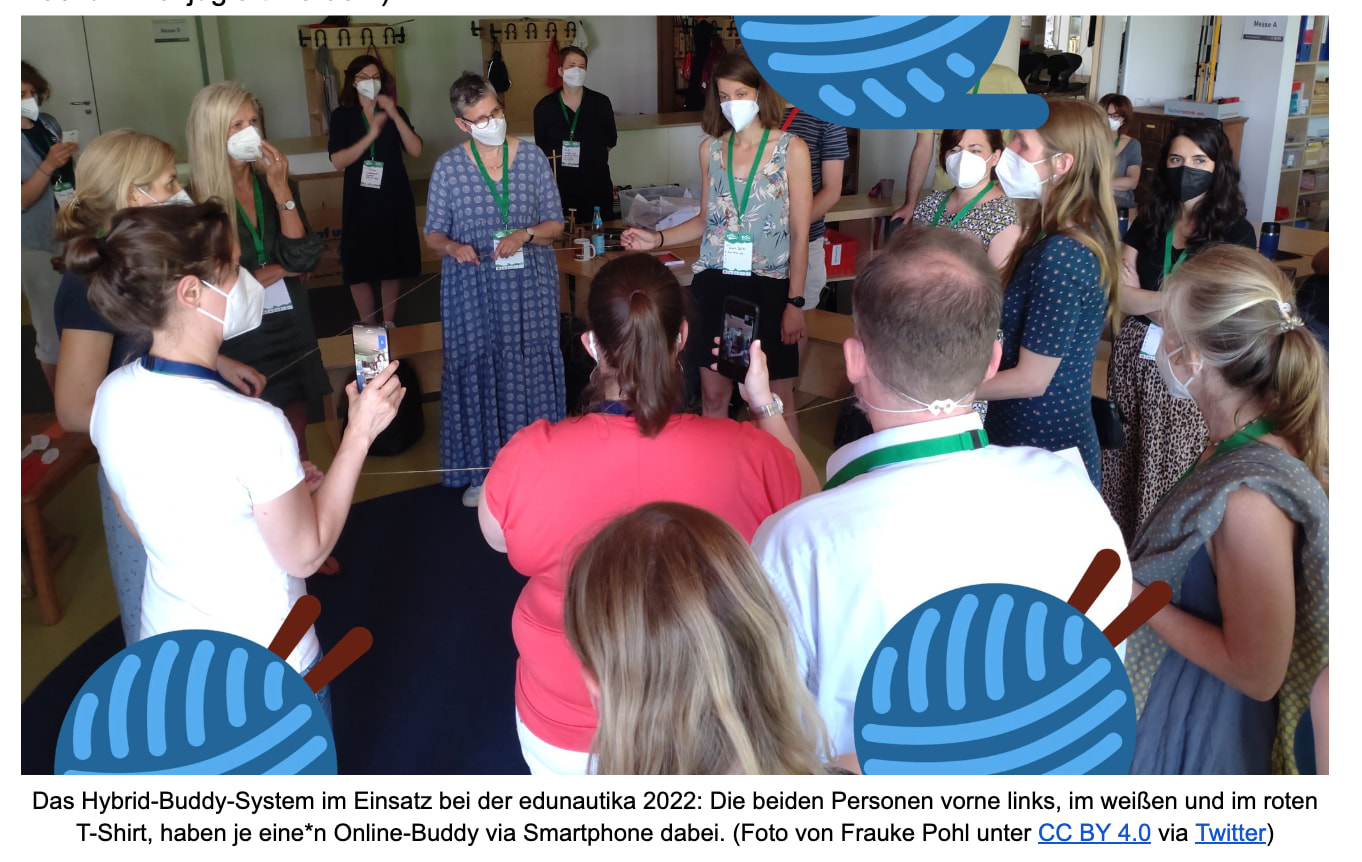
For two or three BarCamps in Germany, we experimented with an idea that I called ‘piggy-back participation’. It’s pretty simple: We connected two people at an individual level. One of them was called the ‘on-site buddy’, and the other was their ‘online buddy’. The former would “carry around” their online buddy by using an individual video call and by signaling their presence at a session or coffee talk table. That’s it.
This solution is, of course, highly intensive and personalised. It’s not suitable for people who want to be a lurker. It’s really demanding on the on-site buddy. Also, both parties have to agree on which sessions to attend. (Although it was reported that two on-site buddies swapped their online buddies for specific sessions.)
1 Like
I like this so much @joeran - yes it is much to organize, but I can see coordinating for a special discussion session.
This is very much in line with what a group of global folks did in the mid to late 2010s with Virtually Connecting led by @mahabali which was like making the hallway conversations possible.
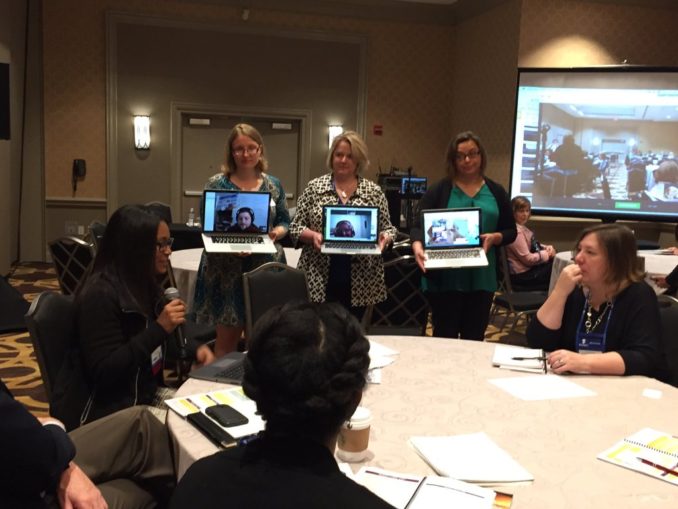
It reminded me of an OLCInnovate Workshop on “Hybridity” where I along with Maha and @koutropoulos where remote by brought into table discussions by in person participants holding us on laptops.
The photo from that session reminded me of the one you shared.
Virtually Connecting Photo taken by Rebecca J Hogue
No it cannot feasibly be done at scale, but its possible, and I honestly remember the feeling that the distance and the notion of who is there / not there disappeared. Or as Maha said in the post:
The main thing with this one is that I felt I managed to have a great convo w/ people I largely ddid not know. There were some ppl on tables that I knew but my table were complete strangers to me and I still had a wonderful time! Ok I better stop. But the main thing is that I felt I was sitting at a table for real.
I have also wondered about a similar idea of a volunteer buddy connection, like someone attending the conference in person agrees to be connected to one or two virtual participants through their preferred messaging platform, so they could have a means of conversing or asking to find more information.
Please keep your brain going on ways we might connect the conference and your active community in Germany.
1 Like
The size of the audience for a given hybrid session certainly impacts how it should be facilitated. At the 2025 OpenEd conference, they conference team did an AMAZING job of incorporating feedback from the online participants during the live sessions. There were moderators in the rooms calling attention to the comments of online participants and the shared Zoom window was visible to everyone in the room. This gave a greater sense of everyone being “together” than I have seen in other conferences.
To be clear, I was not online! It did seem, however, that participants felt heard and included in the sessions. Showing their comments and, where possible, faces, certainly creates a stronger sense of being together.
1 Like
Thanks Mindy, well on point to highlight the facilitation at the OpenEd conferences (I was virtual for 2025 and 2025). This is key because as a remote participant you can feel invisible.
I also found very constructive some of the conversation roundtables I think thery did in Rhode Island, I attended one for Canadian folks. There were colleagues in the room on site and virtually, and it felt like we were at the same table. I’d personally like to see more sessions/opportunities like these than usual slide presentations.
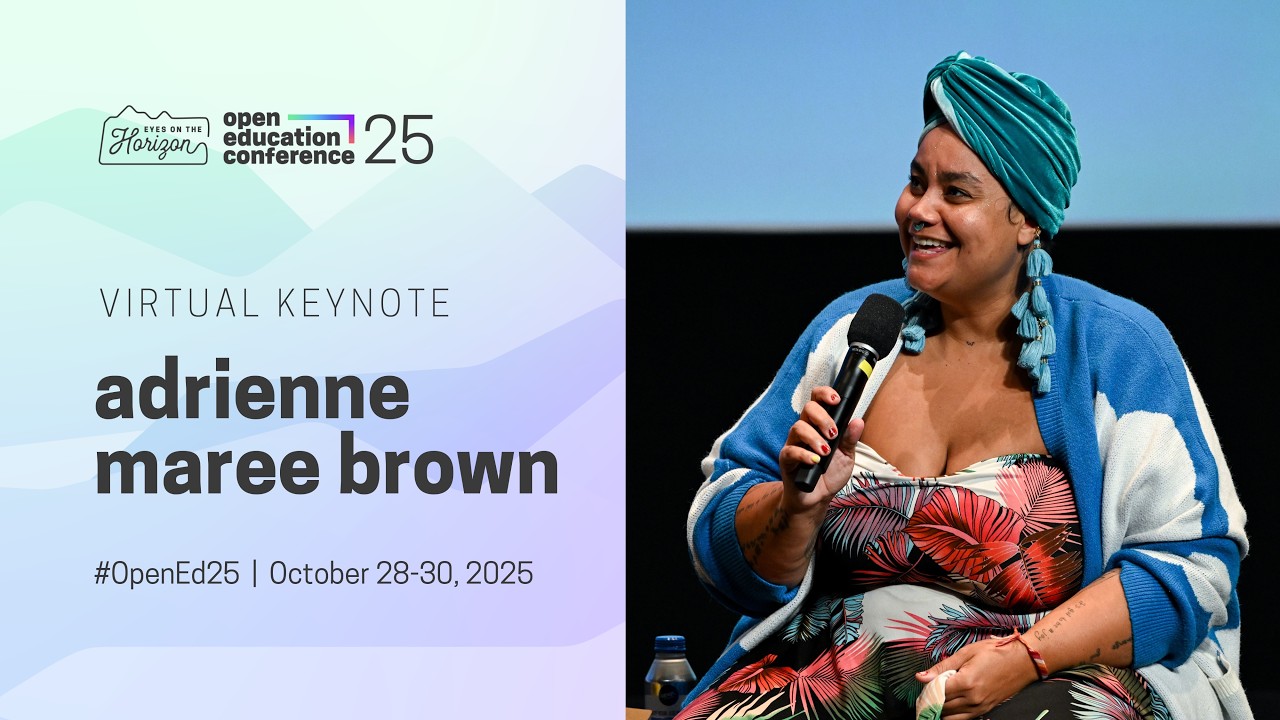
Also the 2025 keynote by adrienne marie brown was inpsiging in many ways, that it was conversational and the fabulous faciliation by @apurva
I was just thinking that conferences usually take a big thing, like “teaching” or “technology in teaching” and the usually conference format breaks it into smaller chunks (the sessions) and then it is done. Over and out.
What if you started small, like with one idea from a session, or one page from a book, and asked the conference goers to make sense of that in their own way, individually or in groups? Like the idea of the small web and connecting those small gardens into a network of plots. Or um, SPLOTS
I don’t know, but time is always a killer. Go here for this thing from 9 to 5 on Monday…
This really never got going, but I do like the idea. I think there is good in here, “This site hopes to provide a prompt for pondering, a short moment of reflection, in a very casual and playful space. Inspiration can be fun. We have made the possibility for interaction by adding the text as a Google Doc. Go ahead, engage with someone.
We believe you can be inspired by words. It is possible it only takes a sentence or a paragraph to learn something deeply. By sharing a single page, you might be inspired to read more of the book? Who knows? That is why a page a week is ok. That is all it needs to be.”
Here is that option.
1 Like