On Language, Translation أقرأ وأكتب اللغة العربية فقط باستخدام ترجمة جوجل

Even with all the latest AI tools we are not quite there (or maybe not even close) with reliable real time language translation. Or maybe we are, that’s not my expertise.

For OER content, accurate translation is a high priority. But maybe for personal communication, getting by with less than perfect, to me, is okay. And actually quite useful (I nearly always include in a message I send that is translated into another language an indication that I have used translatiuon tools). I recently collaborated with French speaking co-authors, and we did all of our email and writing/reviewing assisted with machine translation tools.

But as a mono language reader/writer, I depend much on machine translation to read and communicate in world languages, and I lean much on Google Translate in the browser. Here on several of our OEGlobal web sites notably the main web site but also for Open Education Week we use a WordPress plugin that provides at least hopefully an experience that can be appreciated in languages other than English.

Here is the Open Education Week site translated into Vietnamese.
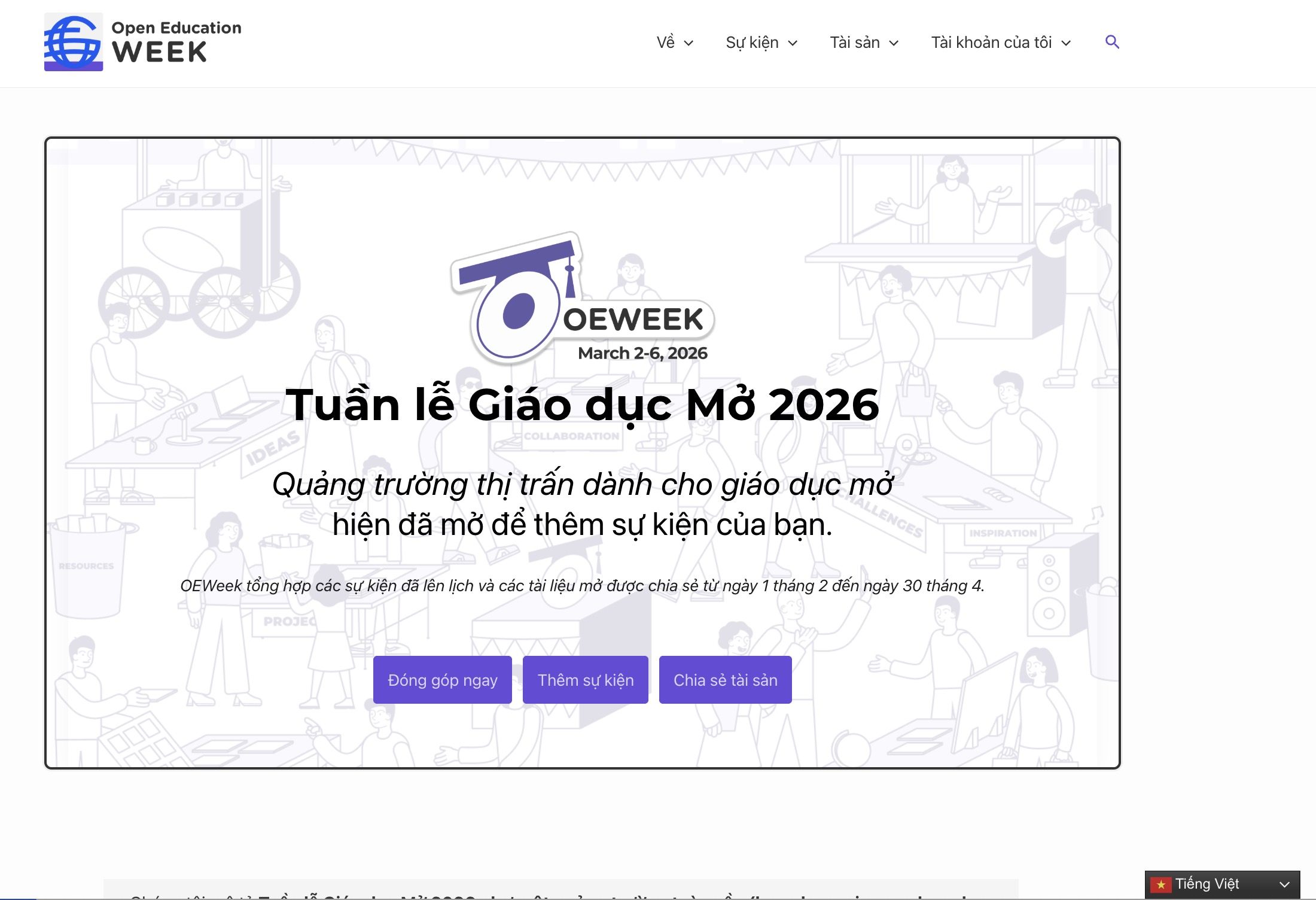
I recently had an interesting experience in editing the newest OEGlobal Voices Podcast with Saida Affouneh.

Saida wrote to me asking if her name as translated into Arabic could be corrected… and indeed I saw it translated as “Happy Woman” which she politely said was not “bad”. I am not sure how Google Translate manages names (nor does it know a word is a name), I did find a place to report a translation issue.

As a small effort I decided to include the correct Arabic spelling of her name in the title (and yes it gets interesting mixing languages).

I did find that if you have access to edit the HTML of your web content (I do) you could put an HML span tag around names or words so Google is instructed to not translate it (reference)

<span translate="no"> </span>

I did put that into use on our podcast episode, but I am not sure it had any effect.

Also to that end, we have been looking into the Discourse AI plugin for this site that would allow automatic translation of content into the language you set as a preference in your profile (this is not yet in play).

What are your experiences using language translation tools for communicating?

1 Like

Cogdog,
There is an implied assumption in your critique of AI translation that courses taught by teachers are always conducted in excellent English. Many profs in our HE institutions are not native speaker, and yet they are well able to teach effectively. Our textbooks are generally good enough, but many would not agree that they are excellent.

In Canada, the federal government’s translation office has been using AI translations for at least 4-5 years, probably longer. Other than in the creative literature, AI translation should be used. And even in creative literature it could at a minimum improve the process. A creative writer plus Gen AI can be better than one or the other.
NO translation can be described as “accurate”. There are many nuances and social attitudes that cannot be properly translated. Any translation must be good enough for the purpose. Should it be an exact translation, a literal translation, a creative translation? So, “getting by with less than perfect” is not only acceptable, but also the norm.

In the meantime, my text above has been auto-corrected and improved by AI. Must we all declare AI use even in informal writing? I agree it must be declared for formal pubications for now. In the future however, IMHO there will come a time when everyone will assume automatically that AI has been used and it will be the few who don’t use any AI who will be declaring.

All the best.
Rory

Rory McGreal, Editor IRRODL

UNESCO Chair in OER

Athabasca University

1 Like

Thanks for the affirmation, Rory, always an honor to read your words.

My practice is less declaring use of AI but in email if I used machine language translation (grey line if AI or not, and it matters little), I prefer to mention it. I do this because there is a good possibility the translation is not clear or matches intent (even with round trip translation back).

I also would like to do everything I can to not make people feel like they have to write in English.

In maybe 2015 on a project in Guadalajara, our group had a driver who spoke no English and only one of our team spoke Spanish. Still, I enjoyed sitting next to… darn I forget his name. We both used what was very new translation of voice once sentence at a time, me saying something in English and playing back for him in translated Spanish. And he did the reverse (while driving??).

We just made it work, and were able to speak more thna just directions.

Thank you for raising this important topic. I often rely on translation tools for reading and communicating, and they are very helpful in bridging language gaps and allowing us to participate in global communities.
However, Google translations are sometimes not accurate enough, especially when it comes to names, specialized terminology, or cultural context. At times the meaning changes or the message becomes unclear. So I see machine translation as a support tool, not a complete replacement for human review.
For open education and academic content, accuracy really matters. Combining machine translation with human editing or proofreading is usually the best approach.
I appreciate you sharing your experience and starting this conversation about multilingual access.