At the end of one of our meetings this week with Andrés Segura-Castillo (UNED, Costa Rica) we returned to hearing a favorite bit of updates from him. Andrés lives on a rural property in Costa Rica deploying sustainable land practices. I always enjoy asking him stories about his herd of goats.
We focus here much on the opens of education, software, data, science, publishing, but there are more broad uses out in the world, for example in farming and ranching.
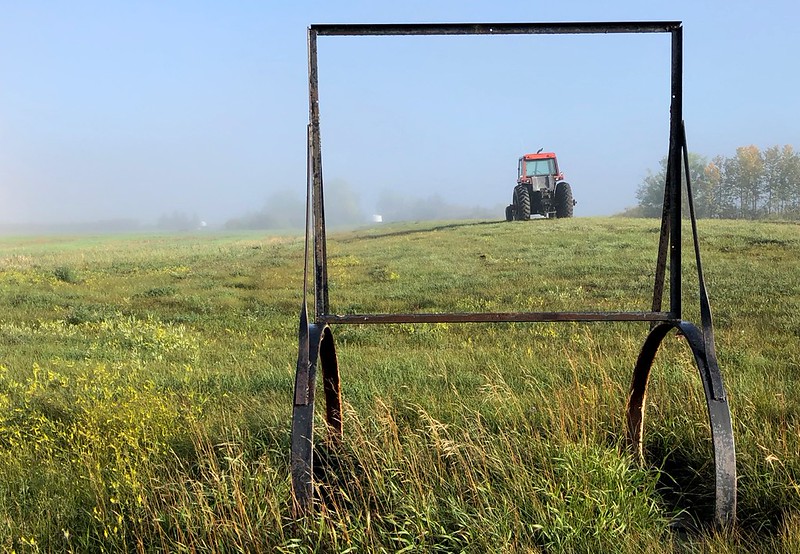
Farming Framed flickr photo by cogdogblog shared into the public domain using Creative Commons Public Domain Dedication (CC0)
As Andrés described the care of his goats and funny stories of them escaping an enclosure to eat plantains, it reminded me of a message earlier this year from longtime, tech oriented friends in Colorado (USA) who run a ranch that specializes in the breeding and care of a rare black Welsh sheep type.
My friends had developed themselves a technology using RFID chips attached to the sheep’s collars that they had made an Android app for reading data and recording vital health data for each sheep, all very important in their breeding program. They recently shared that their original software was now a more generalized one, and one that is completely open source.
The project is called AnimalTrakker
The purpose of AnimalTrakker® is to provide software and data analysis tools that aid in the management of livestock. Our mission is to bring animal management solutions to all who work with animals, whether veterinarian, small farmer, or commercial rancher. Our goal is to make it easier for you to provide your animals with a healthy and comfortable life, all while they provide food, fiber, and other products for human use. Currently, AnimalTrakker® can track sheep, goats, cattle, horses, donkeys, and pigs.
AnimalTrakker® is free and built from open-source, transparent, easily audited software. We feel that every user should be able to edit and modify the software to suit their specific needs. We believe in a future free from control, overreach, and excessive monetization, and AnimalTrakker® is our commitment to that future.
This is very much the spirit of openness, right? Developed by specialists, using existing open source components and then shared back? The software is available on GitLab plus a very comprehensive set of support materials (that leads me to see this is put on the web using the Obsidian notes platform and published with its built in Obsidian Publish, neat discovery on the side).
I’ve had the chance to visit and stay at Desert Weyr Ranch several times, the sheep are amazing! Okay I can brag that one of my CC license photos appears on the front page of the AnimalTrakker site.
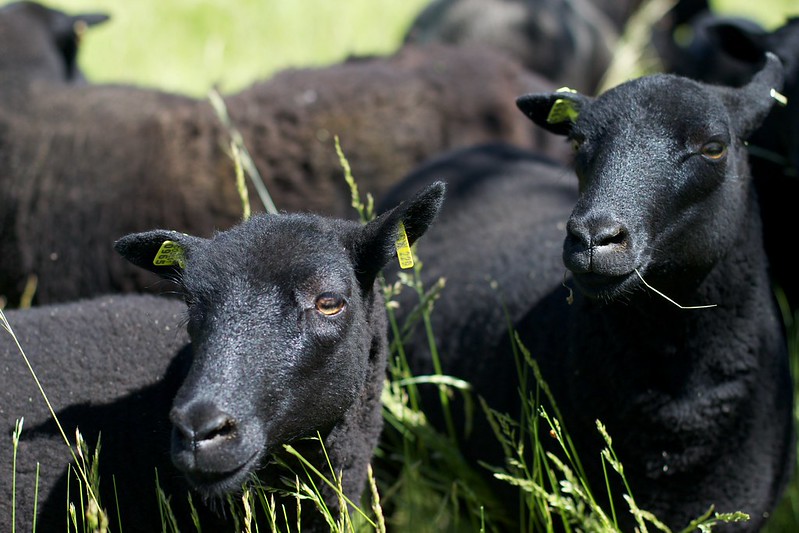
Bahhhhhhhhhhhh Yeah flickr photo by cogdogblog shared under a Creative Commons (BY 2.0) license
While exploring the AnimalTrakker site I found or just got curious about more examples, and landed on FarmOS
farmOS is a web-based application for farm management, planning, and record keeping. It is developed by a community of farmers, developers, researchers, and organizations with the aim of providing a standard platform for agricultural data collection and management.
The farmOS server is built on top of Drupal, which makes it modular, extensible, and secure. The farmOS Field Kit app provides offline data entry via a progressive web app (PWA) at farmOS.app.
Both are licensed under the GNU General Public License, which means they are free and open source. All code is available in the farmOS GitHub organization.
There is a I bet a whole raft of open source tools developed by people who work the land.
So I am curious to hear of more examples of open source or just open practices in other corners outside our usual aim towards education, beyond the open source developer specialists. I know there are many in the health sector.
Where do you see examples of open source in every day practical application?
