[Sharing is a challenge] #10 A journey into the hurdle of complexity by Barbara Class, Mathilde Panes and Henrietta Carbonel

Today, an article straight outta Cantons… We are very happy to welcome our Swiss colleagues Barbara Class (@BarbaraClass), Mathilde Panes and Henrietta Carbonel to help us “navigate [complexity] with some freedom”.

@Barbara, Mathilde, and Henrietta recognise that complexity may be found anywhere, from identifying OER and understanding their licences to decide on what pedagogy and technology to use during the creation process. But they also give us a set of very valuable recommandations to overcome complexity, including: “Prefer “good enough” openness over no co-creation and/or no sharing at all: partial openness and clear documentation beats an ideal OER that is never enacted”, as well as advocate for a “caring systemic approach that prioritises the commons and collective coexistence”.

A great and inspiring article to help us get motivated and take the plunge into sharing. “Complexity is not a reason to give up. It is a challenge to overcome and a reason to foster a supportive ecosystem around OERs and open education more generally.”

A journey into the hurdle of complexity by Barbara Class, Mathilde Panes and Henrietta Carbonel

Barbara Class and Henrietta Carbonel from UniDistance Switzerland, and Mathilde Panes from the University of Teacher Education of the Canton of Vaud, rose to the challenge posed by the technical complexities of sharing. They succeeded in explaining to us why these technical issues are, above all, conceptual issues. And they did so without neglecting to offer us a more practical methodology!

Read the article:

And, as this article focuses on technical complexity (but not only), I refer you to this recent discussion on open source productivity suites.
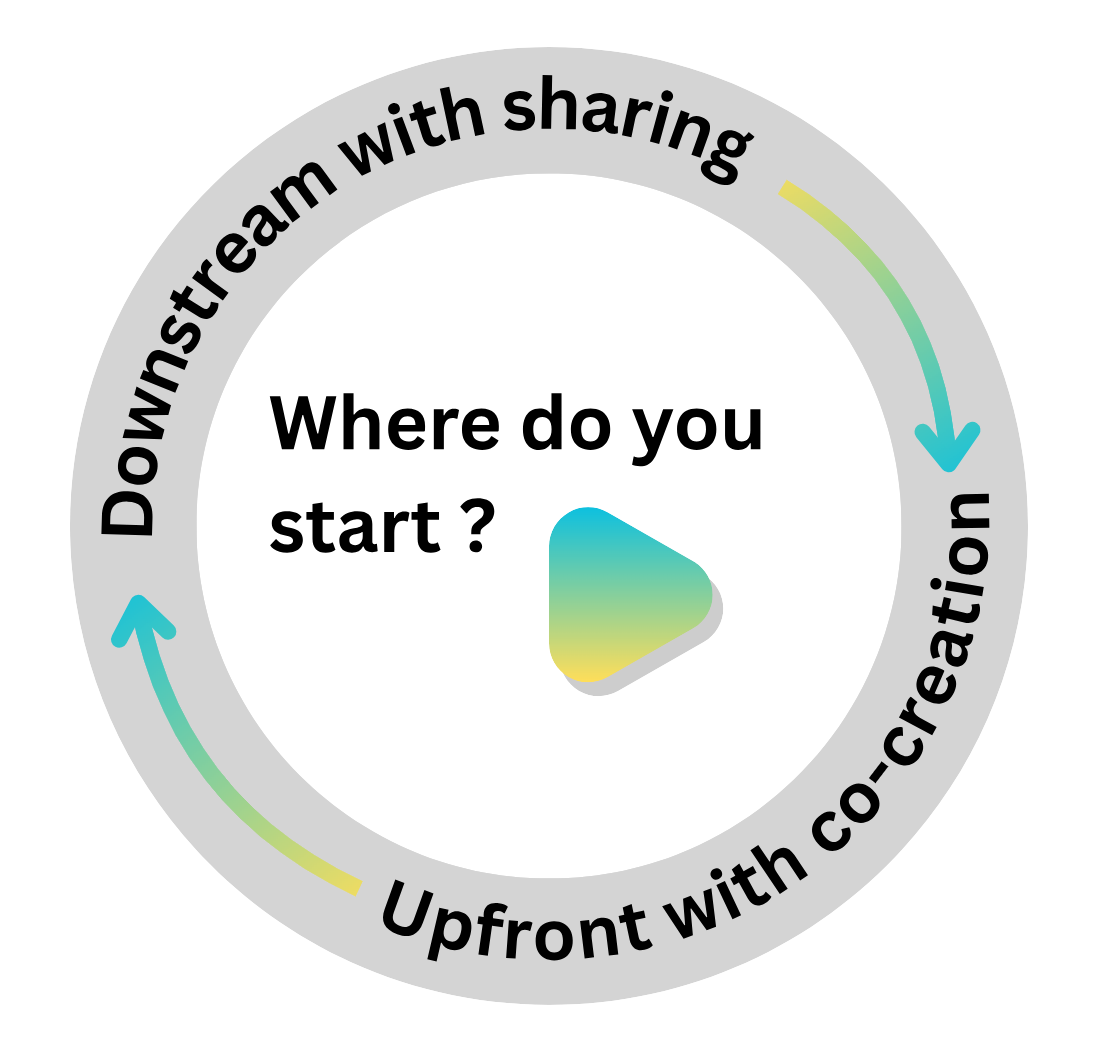
At number 10, double digits, the Sharing is a Challenge series hits another high mark! The authors have really honed on complexity from key angles. I really appreciate the diagram the authors created (CC0) to ask Where do We Start

This deserves some more thought and discussion (anyone?).

I wonder how much complexity is in the things we create themselves and how much we create ourselves? The suggestions the authors made are ones that would definitely address some of the complexity, and the suggestions to be part of communities is sound. At the same time, this community and many others I see are a bit quiet many times, a question and comments I have been listening too suggest there are too many communities and emails and web sites and slacks and social streams. Are we drowning in informatiion?

So a question is for something like file formats, if you try something and get “cannot open”, is that the termination point? Lacking an MSOffice license, I can open and of its docs in LibreOffice. And many document, audio, video, file formats are readily converted with those fleets of online file conversion services.

I reach back to expoeriences ,long ago with what was both a university course on media creation and web media, but one open to anyone and more or less a loose community for Digital Storytelling called DS106. In teaching as a university class or for open, we never specified specific tools to used for image editing or audio editing, we could know what people had. This actually freed up us as teachers from teaching software; we offered an encouraged use of commercial software if students h ad access, if not we would provide suggestions for open source media tools (The GIMP for images, Audacity for audio) as as often there were free web based tools for making media.

I would issue something like a “20 minute rule” - if you as a learner could not find online an answer to how to do something or how to use a tool, stop after 20 minutes, and put out a request for help in a public space, or a course space, or to an instructor, Students learned to figure out many things themselves, but also not to stay stuck if they could not.

The focus (and what was assessed) was not solely on the final media students would create, but on how they would write up their methods, process, sources.

And so I come back to the article as I think we often focus all on the final product the published OER- where do we share the “how I created this?” or “how this was built?” My old and dated metaphor than was movies on DVDs. Yes, we focus on the final movie, but I was always the curious one that opened the menus to find the ancillary information, interviews with directors, actors, out takes, mini reels on the “making of”.

I maintain those are always valuable in the sharing as much as the final shared OER- sharing our practices.