There’s a lot to be said for this article that drew me in, from the richness of the reflective activity, to the embracing of Indigenous perspectives of our relationship to nature, and heck, just a good metaphor.
The river and land metpahor definitely spoke to me, as someone raised on the East Coast of the US but went to Arizona for grad school (n Geology). I relished how different and alive the landscapes were in the southwest, respecting what a summer storm could do in a dry arroyo.
And then I had an opportunity for a Geology class to take a raft trip all the way down the Colorado River through the Grand Canyon. Sure its majestic and sceen by millions through cameras at the top, but spending a week on the river, without any outside communications, alone, was a life filling experience. Not to mention living the rhythms of the river. Long stretches of flat water, moving slowly, our guides reading poetry, and then holding on for those short durations of excitement bounding through the rapids - a vivid experience of change as being quiet punctuated by disruption.
This all got me thinking too of my fortunate years working in the Maricopa Community College system (1992-2006). Our office coordinated a truly amazing program of a systemic approach to technology and learning, that brought together faculty and staff in an oddly named (but perfect metaphor) program named for a desert plant – Ocotillo (Internet Archive Link).
It took some time to find it, but in the early 1990s the Innovation, Collaboration and Implementation (ICI) Committee (my own archive) developed a Chart for Change model that was based on a river metaphor:
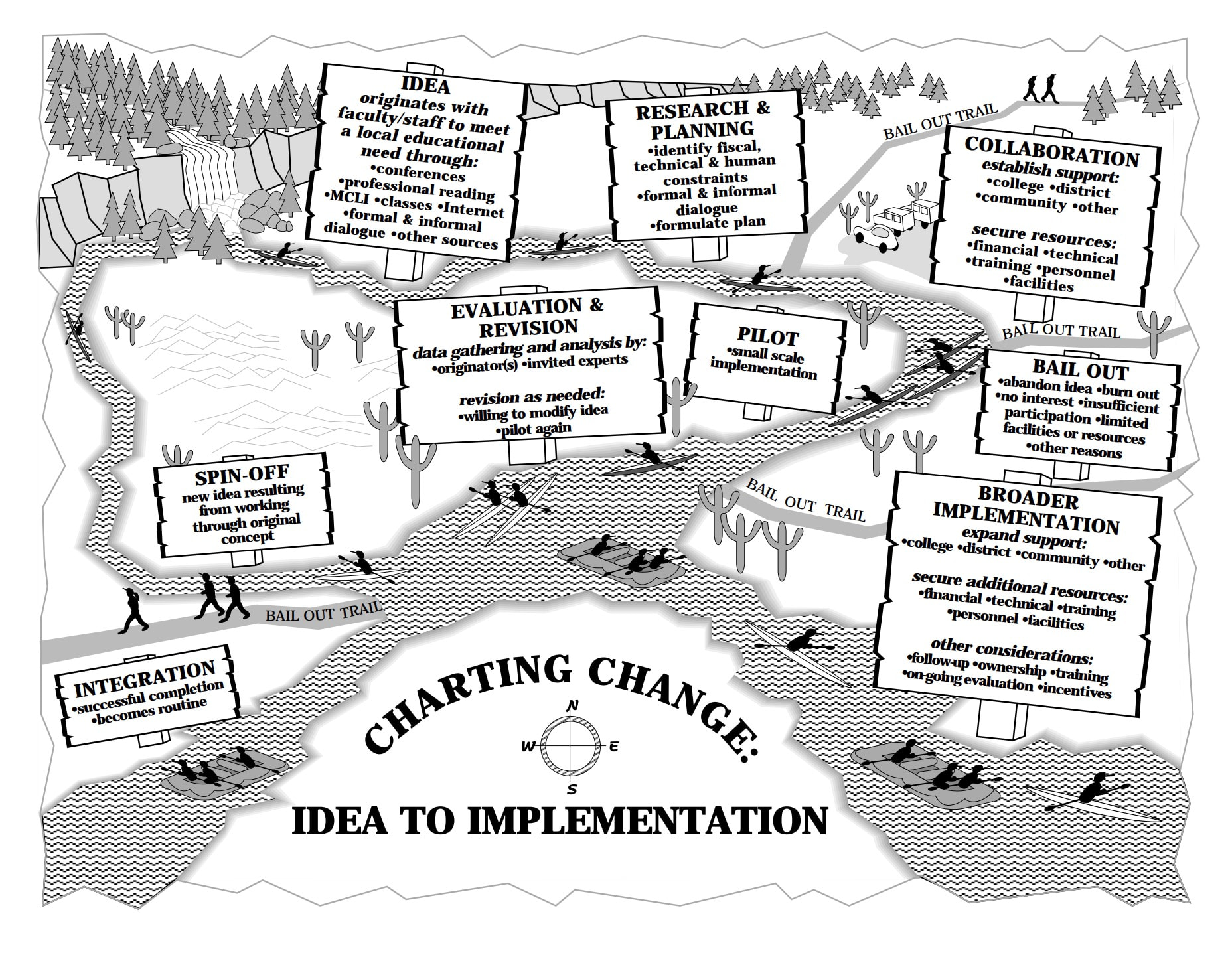
From the brochure Charting Change: Idea to Implementation: It’s a River, Not a Lake
I vaguley remember activites lead by this committee during the annual Ocotillo Retreat where different projects, programs in the system were mapped to the model and discussed.
Ad finally, the last part of that title referred to a comprehensive 1994 report from the Ocotiilo project It’s a River, Not a Lake: A Report on Instructional Technology for the Maricopa Community Colleges.
From the Introduction:
Back in the early Eighties-really, before microcomputers were taken seriously-the conventional wisdom for data processing planning was to make decisions (hardware, software, management, etc.) that would position your company or college in the mainstream; moreover, to make strategic decisions that would keep you in the mainstream. With that strategy, one would not only be current with the current but would constantly adjust toward the center of the flow, neither to be caught in a back-eddy nor flung against the canyon wall on the outside of a sharp turn.
…
This technology river is beyond our control. Like the Gila River at flood stage, it makes its own way. Like the Gila River at flood stage, it will not be ignored. It will leave lasting marks on what we do. Like the Gila River at flood stage, it has raised the cost of doing business; it is forcing us out of comfortable homes, out of formerly-secure content and methodologies.
It was my idea in 1994 with this new fangled thing called “The World Wide Web” to convert what was designed for a printed booklet to be also published on the web. And where it lives now is as an archive on my own web site since the original was washed downstream and lost in a debris flood.
This technology is still a river, even more so, and definitely not a lake.
I count all my fortunes that I got to start my career trip with a put in at the Maricopa Community Colleges in the 1990s.