This wasn’t just adding the labels; we significantly revised our previous AI Declaration page to better reflect OER creation workflows.
The previous version used Kari D. Weaver’s Artificial Intelligence Disclosure (AID) Framework, which is a research-focused framework. We have adapted the framework specifically for educational resource development, including categories like assessment design, media creation, accessibility features, and instructional design. We created an OER-specific AID Framework guide [DOCX] with descriptions and examples for each category.
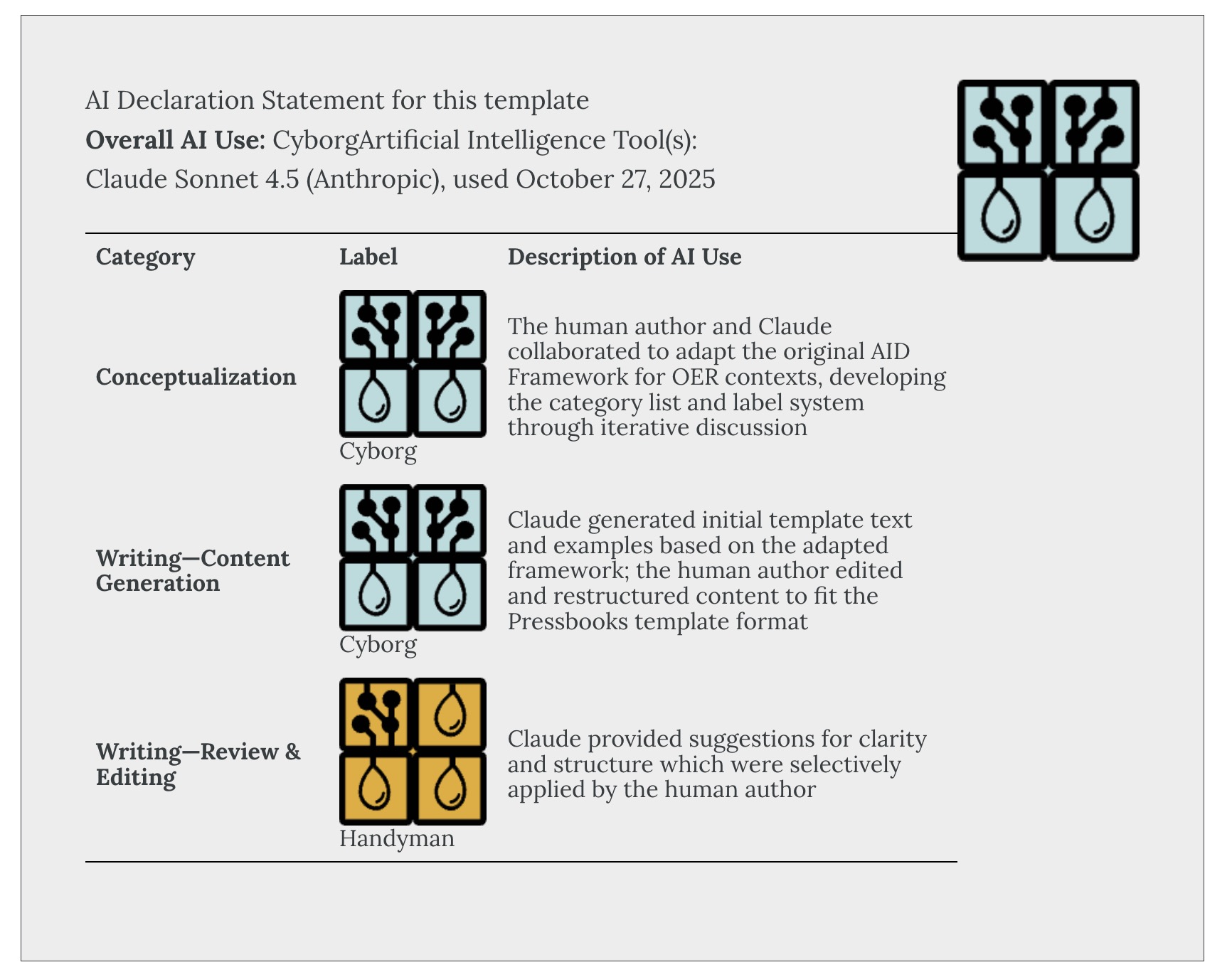
We also created, using the MMM Label system, an AI Use Self-Assessment Rubric [DOCX] to help authors determine appropriate disclosure levels. We modified the labels slightly to represent the role that the author took when using AI, as well as to present more value-neutral language.
I’d love your feedback: If you use these resources or adapt them for your institution, I’d be grateful to hear how they work in practice.
Note: At this point, we’re not trying to encourage or discourage AI use with this template. Our faculty are making really different choices about AI, and we think that’s fine. What we wanted to provide was a consistent way for them to be transparent about whatever they did, so that other faculty considering their OER can make informed adoption decisions. Some of our authors are experimenting heavily with AI, others are using it sparingly or not at all, and this template works for all of them. This is just focused on the disclosure part.
Hi an WOW Amanda, this is outstanding to see this approach that combines the icons/labels of MMM and the AID Framework for making clear the use of AI in OER.
I really, really, really hope others here can chime in and give you some feedback.
For me I am interested in seeing examples of this approach that you are doing at KPU. Of course your own resource for the AI Declaration Statement template demonstrated this for itself!
But perhaps if there was a collection of more examples (?) or perhaps this is just getting started. I’m also curious at what granularity these are done for something like a comprehensive OER as an open textbook? Or is it perhaps done more at the chapter level?
I am keen to give it a try for something smaller I just did yesterday using NotebookLLM and I hope others here might also try on some of their materials.
In a dream world, perhaps there could be some kind of wizard like, even maybe AI powered tool that could help people generate these declarations?
Again, I so appreciate that you have shared this resource and effort. I’d like perhaps maybe talking about organizing an activity to get more people engaged perhaps with Open Education Week?
We don’t have any other examples at the moment, but we’re going to be using it for a few projects this semester and I’ll add them to the template as they finish.
I did think about potential H5P options (Summary, Document Tool, etc.) for a way to help generate it but I wasn’t able to make it work - I hope someone else does! I actually use AI to help; at the end of the project chat I ask it to generate an AI Declaration Statement based on this framework. IMO it tends to overemphasize its own role in the project, but it’s a good start.
I’d love to be a part of an activity or other discussion about this.
It would take something than H5P (which is hard for me to say considering how much I love using it). It is pretty structured, so it could be a form with some conditional branching (like Gravity Forms), but guess someone could craft one of those engineered prompts to ask questions and produce results in the format of your template.
Here’s a small try, as I dont do a ton of GenAI stuff, but for yesterday’s OER Under the Hood Webinar with the Leeds University Learning with AI project I wanted to give it a go with processing the chat log. I typically use a tool that extrats all lines with URLs, but went instead with NotebookLLM to have it:
Generate a summary (which it does automatically)
Compile a list of countries represented in participants intros. It did more, providing also a breakdown for say cities/states represented. Weirdly, it seemed to think the UK was part of the USA (?)
Anonymize the chat by replacing all participant names with asterisks like I would be **** ****** (and leaving host names in chat)
List all web sites - not only pulling out the URLs but including the title / name of the site and/or a description.
Download the chat processed by NotebookLLM notebookLLM-chat.txt (16.8 KB)
So I might declare this