Responding to Canada Survey on AI Transparency

Hi again. Thought I’d stir the pot so to speak by sharing one more idea that has been on my mind. I shared this idea offline with @Peter and he encouraged me to post it here.

The Canadian federal government has issued an open invitation to Canadians to “Have your say on advancing AI transparency in Canada”. The consultation opened July 23 and closes September 23, 2026.

I downloaded the form they are using to invite feedback and have been slowly working on a personal response to the questions from an open point of view. But I keep thinking it would be awesome if a larger group response came from the Canadian open education community. I think a group response would be more thorough, convey a range of perspectives, and carry more weight. I think the government needs to start hearing from open educators and we need to proactively try and shape issues and policy relevant to our work. All that led me to wonder - Is there any interest in collaborating on a collective response?

I know the due dates to this consultation don’t line up with the dates of the satellite event. And I know the due dates are coming up fast leaving little time to organize something like this but I share it here as an open invitation. If this interests you please get in touch.

It’s also an example of things I think the Canadian open education community could be working on together. Perhaps there are other similarly things we could do together at the satellite event?

2 Likes

Thanks Paul for being there and for advancing this action suggestion. Perhaps it can be an open discussion of what happens next or what we can do collectively?? I second the suggestion for this community to reply to the request from the government.

I love this idea and would definitely want to be involved.

@rjhangiani mentioned “A National Advocacy Framework for Open Educational Resources in Canada” from Michael McNally & Ann Ludbrook of CARL/ABRC which may be a great starting point as well.

Thanks for sharing this Rajiv. I hadn’t seen it before. I commend all who were involved. Great work. I’m thinking we need something similar for AI. Happy to participate in such an endeavor.

@agrey @clhendricksbc Thank you both for the interest in responding to the Canadian federal government invitation to “Having your say on advancing AI transparency in Canada.” Here’s a bit more information and a few suggestions from my side.

The consultation questionnaire is extensive. It addresses six areas of AI:

  1. AI Generated Content
  2. AI Interaction
  3. Information about AI Systems
  4. AI Incidents
  5. AI Agents
  6. Broader Considerations

I’ve been finding this framework interesting when looked at through an education lens. Some areas I’ve been tracking and have thoughts on, others I’m aware of but have not explored deeply so don’t have informed feedback.

The feedback form has a lot of questions in each area. Things like:

Would it help you trust what you see online if you could tell whether something was created by AI or by a person? When and for what kinds of content (e.g., image, video, audio) is it most important to know if something was created or modified by AI?

When and why is it most important to know that you are interacting with an AI system? Are there contexts where you don’t need to know that you’re interacting with AI?

Are existing market practices and legal frameworks sufficient to support transparency around AI interactions? If not, where do gaps remain and what actions (e.g., regulatory measures, guidance and codes of conduct, standards and technical solutions, research and development, literacy initiatives, procurement requirements) do you think the Government should take?

These are really big questions. Writing an answer is a significant undertaking. I find myself being both critical and (hopefully) constructive.

I’m not sure we can successfully generate a collective group response to all the questions in the short time remaining before the due date. I considered creating a GoogleDoc and sharing it as a way to generate input and comments I’m not sure that would be effective.

Instead I thought I’d post a few questions from the consultation invite here in this OEGConnect space along with my reply and see if you or others have comments or suggestions. At the very least that might stir some conversation and discussion.

My hope would be that such a discussion might inspire you and/or others to submit a response to the consultation invitation too.

The first question and my response to follow separately.

Thanks so much for the interest.

Here is the first question from the “Enhancing trust in AI through increased transparency” Canadian federal government consultation feedback form:

AI-Generated Content
Question 1: Would it help you trust what you see online if you could tell whether something was created by AI or by a person? When and for what kinds of content (e.g., image, video, audio) is it most important to know if something was created or modified by AI?

Paul’s (Draft) Answer: I am particularly focused on the education sector. In that context it is very important to know whether something was created by AI or a person, or some combination of both. This applies to all kinds of content.

Such a requirement is not that different from how traditional media is currently handled in education. Authorship is stated up front and verifiable. Those who play an intermediary role such as publishers are similarly noted upfront along with contact information, dates of publication, and licensing rights. Content created in an education context by all parties, authors, publishers, students and educators requires references. This practice is what creates trust and responsibility.

Currently AI does not follow any of these practices. AI technologies are not transparent around their source data. This seems largely to be based on the (illegal?) practices AI developers used to acquire data for training their AI models. Disclosing data invites scrutiny AI developers facing copyright litigation don’t want to expose themselves to. Amazingly this practice of non-disclosure has been widely accepted without regulation. Imagine if content generated by a publisher, student or educator did not divulge sources. It would be immediately flagged as unreliable and unacceptable. Imagine if food at a grocery store had no label! It seems odd that we have regulations around food safety requiring disclosure of ingredients but none around AI.

The absence of these practices immediately results in trust issues. AI technologies at this point are black boxes with little to no information disclosed on the underlying sources used to generate AI content and frequently no or fake or low quality referencing. Without addressing this fundamental requirement AI will automatically be untrustworthy.

The Data Provenance Initiative and articles like Sufficiently detailed? A proposal for implementing the AI Act’s training data transparency requirement for GPAI and the AI Transparency Template Blueprint offer a range of approaches.

But the issue is not simply about “content” it is also about the production process used to create the content. In food production there are regulations that specify what is required for food to be designated “organic” or “fair trade”. In addition, there are legally defined and protected geographical regions defining where only certain food products can be grown and associated laws that prescribe rules that must be followed around how the food is made within those boundaries. AI is currently completely devoid of such rules and regulation. This has resulted in AI slop and AI hallucinations.

In education it has also resulted in transference of cognitive function from human to machine with few or no guardrails and little consideration of the consequences. Cognitive offloading to AI is not a positive step forward for education or society overall.

Creative Commons notes “Attribution has always been a cornerstone of the commons. It supports participation, enables transparency, and allows knowledge to be traced, evaluated, and built upon.

Today’s AI ecosystem is eroding this norm. Most generative systems do not meaningfully acknowledge the sources they rely on. As AI increasingly mediates access to knowledge, this has serious consequences: loss of provenance, reduced trust, and fewer incentives to share.”

From my “local” scene I am just reading in CBC news how Saskatchewan is trying to make a big play in building AI data centers, asking “Who is accountable, and who benefits?”

It mentions the appeal of Saskatchewan for data centers of large amunts of land and cold weather, hinting at an advantage of less need for cooling? (neglecting the summer temps in the high 30s), nor mentioing the impact of water and power demands.

https://www.cbc.ca/news/canada/saskatchewan/saskatchewan-ai-data-centre-boom-benefits-accountability-9.7341125

From there I searched a references to AiSK Artificial Intelligence in Saskatchewan, with a strategy

Artificial Intelligence Saskatchewan (AiSK), pronounced “Ask”, is a non-profit organization created to champion the growth of the Artificial Intelligences sector in Saskatchewan.
The field of AI represents an economic growth opportunity for Saskatchewan. AiSK will help the province seize this opportunity by creating a “one-stop shop” for AI in Saskatchewan by bringing together the public, industry, academia and all levels of government to create a thriving AI sector.

AiSK’s site full of GenAI generated images of people and robots and nary a thing that looks like the province. It pitches memberships and seems to be loaded on their board with industry reps and at least one rep from Sask Polyech. They seem to be pushingan AI Student Network and some kind of Ai Literacy program

“AI Learning for all of Saskatchewan”
10K AI SK
A province-wide mission to make 10,000 Saskatchewan residents and businesses confidently AI-literate — online or in person, The first modules go live Fall 2026

It’s all about pushing the jobs and economic impact.

The data center is being built by Bell Canada just south of Regina on 160 acres of farmland described as a “campus”- the project has been endorsed by the University of Regina.

@cogdog Thanks for sharing the AI news from Saskatchewan. So much to unpack.

A similar issue is unfolding here in Vancouver where I live as described in this Hundreds march in Vancouver to oppose planned AI data centres CBC article Hundreds march in Vancouver to oppose planned AI data centres | CBC News And street signs https://www.instagram.com/no.ai.vancouver/

Here in Vancouver the issues are primarily water and power usage plus lack of consultation.

I think a great deal of the underlying reason behind protests in both Saskatchewan and Vancouver has to do with the lack of consultation. A pivotal quote in the Vancouver article goes “We were not consulted, we don’t benefit from this, this doesn’t do us any good and we’re sick of essentially not being in charge of our own communities.”

Some of the right words are being spoken like those from Evan Solomon, Canada’s federal minister of artificial intelligence and digital innovation in the CBC Saskatchewan article, “How we build matters.” says . And supposedly local municipalities are supposed to be involved. (I’ve not seen any evidence of that but maybe?) But the primary issue is there has been minimal consultation with the public.

I like the five expectations in the government’s framework: “that the centres create lasting local benefits; that they not shift electricity costs to Canadians; that they minimize water use and environmental impacts; that their owners be transparent about local impacts and that they bring strategic value to Canada.”

But the public consultation part has not been visible and as a result many people feel excluded. Developments are announced as already decided and underway and people wonder how decisions were made and why they weren’t consulted. This is, I believe a big problem.

As I follow the issue in Vancouver I’d also say there are a few other issues:

One is “noise”. How much noise does an AI data centre generate and will it adversely affect those who are in near vicinity?

Another is whether AI makes economic sense and a desire to see the public benefit in very real ways including public or community ownership, as suggested in the Vancouver article.

Regarding the economics of AI I’ve never heard of the argument that placing an AI data centre where the climate is cold makes economic sense. But given “cooling” is a major operational need of an AI centre I wonder if placing AI centres up north is actually a good idea? If that is truly the case then further north the better would seem a sensible strategy calling in to question the south of Regina location. :slightly_smiling_face:

And finally I’d say here in Vancouver there is a growing sense that people are losing trust in tech players. And the actions of those who currently make up the public face of AI aren’t helping make things better.

I think it’s great that these issues are coming to the fore but I also agree with Solomon in the Saskatchewan article when he emphasizes the between Canada’s domestic digital infrastructure and its sovereignty. This is something I think is critical for Canada.

This dialogue makes me realize that the “Enhancing trust in AI through increased transparency” Canadian federal government consultation I’m trying to respond to is asking a very narrow set of AI questions. Consultation with the public on these larger issues is largely absent.

Thanks for sharing all this.

I wonder how this is playing out in other parts of Canada?

Here is my response to the second question from the “Enhancing trust in AI through increased transparency” Canadian federal government consultation feedback form:

AI-Generated Content
Question 2: What would best help Canadians determine when content is AI-generated (e.g., invisible or visible watermarks, disclaimers, provenance metadata)?

Paul’s (Draft) Answer: AI technologies have tried to push the notion that AI is human-like by creating personifications through things like using human names (e.g. Claude) or calling them “agents” (personification akin to being a travel agent). But AI is not human like. It is simply a statistical prediction technology.

A better analogy might be to consider AI like a country. We are used to seeing “Made in …” designations specifying country of origin. AI generated content could be simply designated “Made by AI”. This designation could contrast with the default assumption of “Human made”.

In the capitalist marketplace we are also used to seeing brand names associated with content – Nike, Apple, etc. So the designation could be “Made by (brand or application name) AI”. This might provide further clarification as to quality or trustworthiness. I think there are opportunities to express a broader range of provenance meta data too.

A significant challenge lies when content is produced by a mix of AI technologies, or content created by a mix of AI and humans. Clothing labels might provide some direction where fibre content of clothing is often designated using percentages (e.g. 50% wool, 50% cotton).

Attribution for AI provides a starting point for labelling.

From Prompt to Practice: A Framework for Transparent GenAI Use in Higher Education provides a framework for education that could also be relevant for use in other contexts.

It is also interesting to see certain businesses adopting to exclude AI and embrace human creation. The Noun Project has released new Terms of Use specifying “AI-generated content may not be submitted to Noun Project’s icon collection, which will remain human-created.”

AI slop batters book publishing illustrates what can potentially happen when content is not appropriately labelled as AI generated. It also reveals the complexities as content can, and often is, a mix of human and AI generated. Such issues raise significant questions about the desirability of AI and call into question the constant hype of how AI is a good thing – including hype in the vision set out in Canada’s National Artificial Intelligence Strategy: AI for All.

I think the public currently questions the benefits of AI. Benefits to the public are still more hypothetical than real.

This just in- the size and scope of the Regina data center will be quadrupled

https://www.cbc.ca/news/canada/saskatoon/bell-canada-ai-data-centre-size-expansion-investment-9.7343780

No answers on where the water or power will come from.

I don’t think there’s much protest happening here.

Here’s the latest on AI data centres in BC What you need to know about AI data centres coming to B.C. Interesting chart showing how Canadians feel about data centres in their area.

Here are my answers to the third and fourth questions from the “Enhancing trust in AI through increased transparency” Canadian federal government consultation feedback form:

AI-Generated Content
Question 3: Who in the AI value chain (developers, deployers, or others) should be responsible for providing transparency around AI-generated content? Why?

Paul’s (Draft) Answer: All players in the value chain have an obligation to provide transparency around AI-generated content. Going back to my earlier reflections on education every player in the education value-chain is expected to give attribution and acknowledge sources. They are also responsible for the legality, accuracy and validity of the content they produce. This should be true for AI too.

Focusing only on transparency is to limiting Developers and deployers should be responsible not just for transparency but for accuracy. As noted in Google’s Ambitious AI Search Changes Are Risky. Here’s Why “AI has a confidence problem. The sourcing problem in AI search is not a fringe concern. It’s been documented repeatedly, across multiple platforms, by independent researchers with no particular stake in the outcome.

A study published in 2025 by Columbia University’s Tow Center for Digital Journalism tested eight generative search tools, including Google’s Gemini, ChatGPT Search, Perplexity, and others, across 200 queries. AI search engines failed to produce accurate citations in over 60 percent of tests. Gemini and Grok were the worst performers, providing more fabricated links than correct ones. The study’s authors noted that content licensing deals with publishers, the kind AI companies have spent billions on, provided no guarantee of accurate attribution in the responses that followed.

A separate study, using the DeepTRACE evaluation framework, tested systems including Bing Chat, You.com, and Perplexity across 303 queries, scoring answers on whether claims were actually supported by the cited sources. Bing Chat had unsupported statements in 23 percent of cases. Perplexity reached 31 percent. Perplexity’s deep research agent performed worst of all, with 97.5 percent of its claims unsupported by cited sources. The researchers concluded that “current public systems fall short of their promise to deliver trustworthy, sourced responses.”

And research published jointly by the European Broadcasting Union and the BBC in October 2025 found that leading AI assistants misrepresented news content in nearly half of all responses tested, with 81 percent of responses containing some form of problem.

When asked about hallucinations at the time of the AI Overviews launch, Google CEO Sundar Pichai called them “an unsolved problem” and, in a phrase that deserves to be considered carefully, “in some ways an inherent feature” of large language models.”

Given this extent of inaccuracy it seems imperative that actors in the value chain be held responsible not just for transparency but for accuracy. It is interesting to note that that increasingly responsibility for accuracy is falling on end users rather than those who produce the underlying systems themselves as outlined in Beyond the Mirage: Beware of Generative AI and Hallucinations, and Academics in Meltdown Now That They’re Responsible for AI Hallucinations in Their Research Papers.

Question 4: Do existing market practices, technical tools, and legal frameworks make it easy enough to know when content is AI-generated? If not, where do gaps remain and what actions (e.g., regulatory measures, guidance and codes of conduct, standards and technical solutions, research and development, literacy initiatives, procurement requirements) do you think the Government should take?

Paul’s (Draft) Answer: There is a significant push to define the lack of trust in AI as a literacy issue. I think this is a false narrative. I think people are pushing back against the spread of AI into their daily lives without it being something they want. Librarians are hosting viral ‘Avoiding AI’ workshops for people who are fed up with Big Tech. There is a very real sense that AI is being forced on us. See Don’t like AI being forced on you? These librarians have the perfect first step. There is even a growing push related to anti-AI clothing. See also This shirt is like an AI invisibility cloak.

Another factor is the very real pushback against the consolidation of power related to AI in the hands of a very few high tech players. This is an equity and social issue that market practices have created. At this point in time AI technologies are not engaging in fair practices associated with reciprocity - see The Tragedy of AI. Furthermore the promise of AI to eliminate jobs, consume vast amounts of power and water to the detriment of citizens has resulted in booing of AI promoters at commencement addresses and protests against data centres leading to Canadian petitions like this. Transparency related to impact of AI on the public is swept under the carpet and replaced with ideas like watermarks. In the US Bernie Saunders introduced an AI Moratorium Act to completely freeze the construction and upgrading of new AI data centers until government passes comprehensive safeguards against job displacement and ensures these facilities do not raise utility prices for consumers.

AI has been overly hyped and is nowhere close to fulfilling the promises being made. AI has yet to even make business sense. See Is AI Profitable Yet? What will Canada’s response be to the bubble bursting? I found Bernie Saunders proposal for an AI Sovereign Wealth Fund Act arguing for public ownership of AI compelling. I like his view that:

"“It would do two extremely critical things,” Sanders said of his legislation. “First, it would give the American people a direct role in determining the future of this technology. No longer would the future of AI be dictated by a handful of Big Tech oligarchs, while the rest of the world sits back and watches them do what they want.

“Secondly, it would guarantee that the trillions of dollars potentially generated by AI are used to improve the lives of all of us — not simply to make the richest people on Earth even richer.”

And there is a very real issue related to transparency not just of the AI tools but of the entire AI technology stack (compute hardware, cloud platform, source data, enhanced data, models, API’s, apps and applications). AI relies on a suite of underlying technologies which are consolidated into the hands of a very few tech players. The consolidation of the underlying stack associated with AI in the hands of a few high tech players is largely opaque to users.

The issue isn’t just “transparency” it is also sovereignty. The Sovereign AI Index captures some of what is happening and shows Canada’s position, but it would be super helpful if Canada was more transparent around this effort and investing in a sovereign, public benefit approach to AI not a big tech one. I also think Canada should consider the sovereignty benefits associated with an open source approach to AI. The European Open Source strategy is one we too should take.

I think taking a Public AI approach will generate the greatest transparency and benefits to Canada.

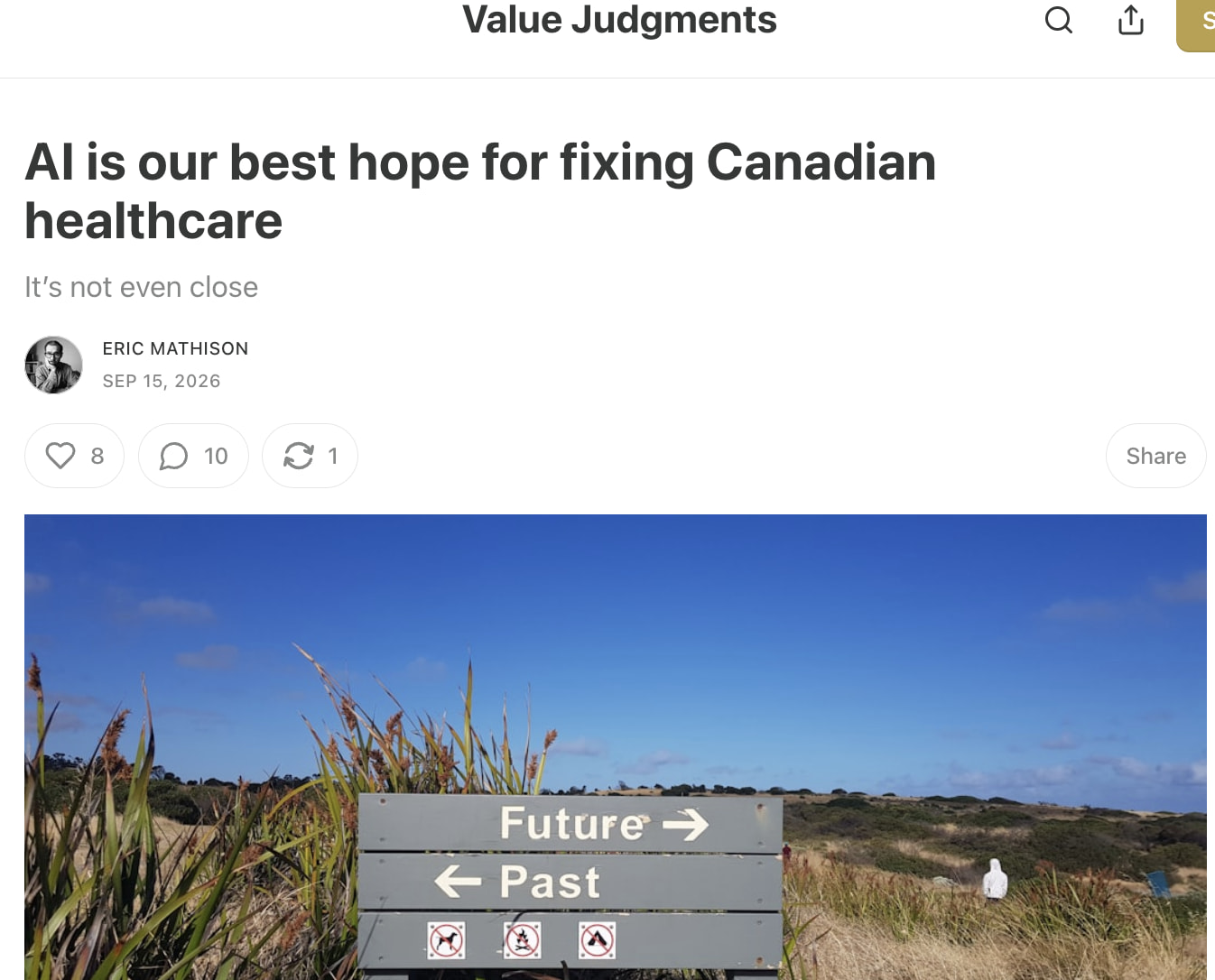
In looking for Canadian perspectives on AI I came across this article - AI is our best hope for fixing Canadian healthcare .

Interesting to consider the feasibility, trustworthiness, and effectiveness of the health tasks this article recommends AI do.

I thought I’d give a final update on responding to Canada’s Survey on AI Transparency. I submitted my response to the survey questions on September 22 the day before the due date of September 23 2026. Submissions are anonymous but it feels good to take the initiative on providing feedback.

Thanks for letting me share the process of providing feedback, including some of the questions the federal government asked and my responses, here in the lobby of this forum. I can see how hard it might be to prepare a collective response as a group or organization. Still I dream of a collective open education voice on AI.

I especially appreciate the broadening of the discussion in this forum to include actions citizens across Canada are taking in response to AI. It’s made me super interested in learning more about how citizens across the globe are responding to AI.

I appreciate the Canadian government making it possible for citizens to have a say. It’s also interesting to see how governments around the world are responding. The EU Artificial Intelligence Act https://artificialintelligenceact.eu/ provides one comprehensive response from a European frame of reference. I believe Japan, South Korea, and China also have their own AI Acts. It would be super interesting to see how they all compare and the extent to which they not only align with national interests but fit with citizen needs and open education values around the world.

I look forward to learning a lot more about AI and open education in the upcoming OEGlobal conference. If you’re going to be attending the OEGlobal conference satellite event in Vancouver I’ll see you there.

1 Like

Thanks for doing the good work, Paul! Curious to see how this all plays out.

And as well thanks for (humanly) summariizng the discussion so far in your blog post