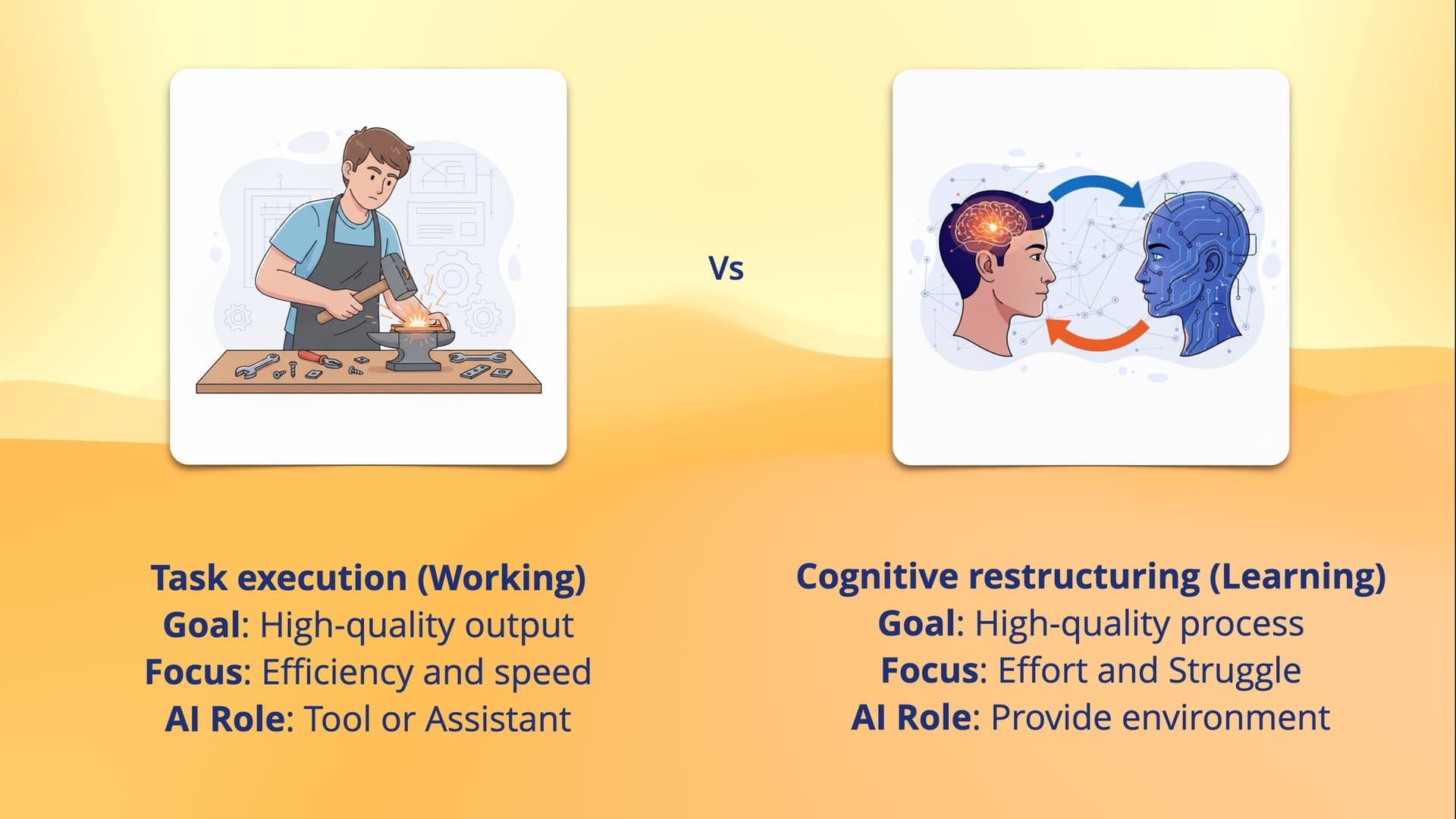
What’s of interest? AI for work vs AI for learning: are you getting it right? (Martin Dougiamas)
Tell me more!
The tools can certainly be powerful, but I find the conversation around them, especially in the education world, is often muddled. For example, we get confused about how to deal with AI in the context of assignments, or we get hung up on how a specific .com service behaves.
I think the main reason is that we’re conflating two very different things: AI for Work and AI for Learning. We need to get this right.
The simplest way to understand this is to separate the output from the process.
Work (Task Execution): When your goal is a high-quality output (an email, a report, a piece of code) and your focus is on efficiency, AI is a phenomenal tool. You can offload (some of) the cognitive work to a machine to get a job done.
Learning (Cognitive Restructuring): When your goal is a high-quality process (to build a new skill, change your thinking, or deepen your understanding) your focus must be on the brain’s effort and struggle.
Getting an AI to write your assignment for you is like sending a friend to the gym to do your workout. It doesn’t help your muscles; it helps theirs. You get the output (the completed workout), but you miss the entire benefit from the process of struggle and growth.
Learning is work. It’s supposed to be difficult. Neuroscience calls this “desirable difficulty,” and it’s the only way we truly build new neural pathways in that lump of meat we’re thinking with right now.
This is one among many items I will regularly tag in Pinboard as oegconnect, and automatically post tagged as #OEGConnect to Mastodon. Do you know of something else we should share like this? Just reply below and we will check it out.
The distinction between AI for work and AI for learning is indeed essential in educational contexts. The analogy used by the author is quite powerful—it highlights the importance of focusing on the learning process rather than just the final output.
It might be valuable to develop frameworks or policies that guide both students and educators in using AI tools ethically and effectively, in ways that enhance critical thinking and genuine learning.
Does Open Education Global have any initiatives exploring this distinction in curriculum design or teacher training?
I am hopeful this question and ,more posted by former OEGlobal Board member Martin Dougiamas @moodler leads to more discussion and responses here.
I’d agree that much we hear of GenAI is focused on the idea of improving, speeding up, even offloading what are seen as tedious tasks, be it summarizing large complex works, outlining documents, heck even podcasting on the fly. The suggestion, and I think I’ve heard it a bit in Martin’s work is, if we can offload more of the former (AI for Work Tasks) we can focus on the latter, which perhaps takes more than typing in a box (AI for Learning).
Martin suggests 5 approaches to AI for Learning, all with sample prompts and why it might be effective.
The Socratic Tutor
The Practice Partner
The Simulation Engine
The Instant Feedback Loop
The Scaffolding Tool
We are keen to know and hear more about specific examples of AI for Learning in this approach Martin shares (or others) - like this AI Critical literacy game she created with Gemeni, being an example of what she is asking her students to do as well.
I am confident there is much much more out there. How are you seeing AI for Learning in action where you are?
And consider Martin’s advice:
The next time you’re using AI in a learning context, ask yourself this one question to help help sort out any grey areas: Is this just Work? or is it Learning?
For Work, use AI to offload cognition.
For Learning, use AI to provoke cognition.
Our job as educators and technologists is to focus on the second.
What does “provoking cognition” look like in practice?
If you mean “Open Education Global” the organization, then no- we are way to small a team to be tackling such a broad landscape. Our role is to catalyze, connect, and bring together efforts in this area around the world.
But we are keenly interested in hearing how organizations are thinking about this distinction. I’d say one important avenue is listening to what students are saying about they ways they are using GenAI and their perspectives on what they anticipate in their own future. It may be misguided to focus on the “cheating” side.
That’s we are bringing the communty November 19 in an OER Under the Hood webinar with students and staff from the University of Leeds who are running ongoing efforts, led by students, to collect these in the OER Learning with AI: A student edited collection. Details on this webinar here
I was also impressed with the voices of students shared in this episode of the Learning Curve podcast on How Do Students Feel About Their AI Use? It’s Complicated where host Jeff Young visited a university campus to record students describing their actual use of GenAI- it’s a far cry from shortcutting assignments.
Thank you for sharing this crucial perspective on AI in education. I wholeheartedly agree that the core of the muddled conversation stems from the failure to distinguish between AI for Work (Task Execution) and AI for Learning (Cognitive Restructuring). Your analogy of sending a friend to the gym to do your workout perfectly encapsulates the danger of conflating the two.
The emphasis on “desirable difficulty” is spot-on. True learning necessitates mental effort—the struggle that builds new neural pathways. When AI removes this struggle entirely for a student, it bypasses the very mechanism of growth.
An Invitation to Deeper Discussion
These are precisely the issues I explore in depth across my last two books, which I believe offer frameworks that align with and expand upon your argument. For a limited time, both books are currently free on Kindle:
Nemesis Unleashed: AI Unification Emancipation: This work examines the societal and ethical shifts caused by highly efficient, “work-oriented” AI. It specifically looks at how emancipation from tasks through AI redefines the purpose of human labor and, consequently, the goals of education.
Prometheus Unbound: AI for a Liberated Future: This book focuses on the emancipatory potential of AI—not just from mundane tasks, but from obsolete learning methods. It proposes specific pedagogical models that leverage AI to increase the “desirable difficulty” in complex problem-solving, rather than diminishing it.
Artificial intelligence (AI) is currently one of the most powerful technologies transforming both work processes and learning environments. However, the purpose of using AI in these two domains requires completely different approaches. In many cases, people use AI tools designed for work in the same way during the learning process, and as a result, the expected development or knowledge formation does not occur. This creates the dilemma of “AI for work vs AI for learning.